Download your free grammar guide here.
Download your free grammar guide here.
What are irregular verbs?
What are irregular verbs?
- Home
- Verb Tenses
- Irregular Verbs
Irregular verbs are "not regular verbs." If you listened to your vocabulary teacher when you were a kid, you know that the prefix ir- means not, which would help you remember that these are not regular.
But, before you learn about these not regular verbs, you need to learn about simple verb tenses and regular verbs. Let's get started!
Quick Refresher
A verb is a word that names an action or a state of being.
Verb Tenses
1. Past Tense: These verbs take place in the past.
2. Present Tense: These verbs take place in the present.
3. Future Tense: These verbs take place in the future.
Past tense and present tense are the two tenses that are important for this discussion, so those are the two that we are going to focus on.
Look at these examples of past and present tense verbs.
| Present Tense | Past Tense |
| kick | kicked |
| talk | talked |
| move | moved |
| push | pushed |
| swim | swam |
| cost | cost |
| sit | sat |
| wear | wore |
Regular Verbs
The verbs that followed a pattern are examples of regular verbs.
Regular verbs add either a -d or an -ed to the present tense form to create the past tense form.
This chart shows how regular verbs are formed:
| Present Tense | + -d or -ed |  |
Past Tense |
| kick | + -ed | |
kicked |
| talk | + -ed | |
talked |
| move | + -d | |
moved |
| push | + -ed | |
pushed |
Irregular Verbs
These are the ones that don't end in -d or an -ed in their past tense.
| Present Tense | + ? | |
Past Tense |
| swim | + ? | |
swam |
| do | + ? | |
did |
| have | + ? | |
had |
| freeze | + ? | |
froze |
| break | + ? | |
broke |
| steal | + ? | |
stole |
| cost | + ? | |
cost |
As you can see, these verbs don't follow a pattern. It's because of this that they are not regular.
So, if they don't follow a pattern, how do you know how to form the past tense form of an irregular verb?
Luckily, you'll find this information in a dictionary. When in doubt, look it up.
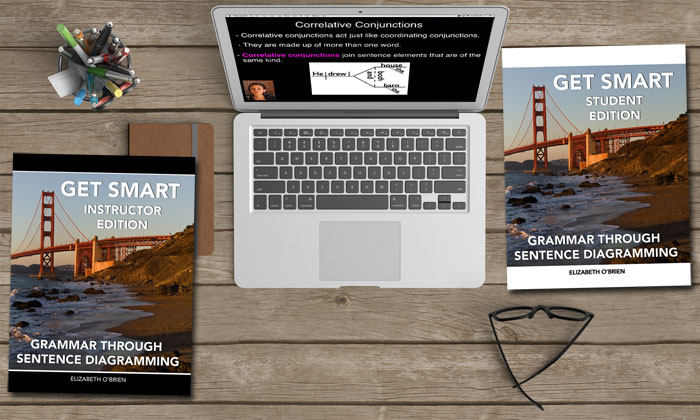
If you'd like to teach or learn grammar the easy way—with sentence diagrams—check out our Get Smart Grammar Program.
It starts from the very beginning and teaches you grammar and sentence diagramming in easy, bite-size lessons.

Hello! I'm Elizabeth O'Brien, and my goal is to get you jazzed about grammar.
Thank you for the wonderful way in which you teach this material. Everyone is enjoying it, having fun, and learning at the same time. Yeah!
- Maria, Mom

Our Free Guide Gives You A Fun Way
To Teach And Learn The Basics v

Elizabeth O'Brien is the creator of Grammar Revolution.
Her lessons are guaranteed to give you more confidence in your communication skills and make you smile. :)
- Home
- Verb Tenses
- Irregular Verbs



Home BLOG SHOP Contact PRIVACY POLICY Your Purchases
Copyright © 2009 - 2026 Grammar Revolution. All Rights Reserved.