📘 Download your free grammar guide here. 📘
📘 Download your free grammar guide here. 📘
Are you ready to learn sentence diagramming?
Are you ready to learn sentence diagramming?
- Home
- How to Diagram
Put on your party hat because it's time to start diagramming sentences!
Use the step-by-step grammar exercises below to help you learn or teach grammar the easy way—with sentence diagrams.
We'll start from the very beginning, so don't worry if you're new to grammar or sentence diagramming. I'll help you learn everything you need to know.
Chapter 1: Start Basic Sentence Diagramming
The simplest sentences consist of a subject and a verb, and the simplest sentence diagrams consist of two lines. The subject goes on the left side and the verb goes on the right side. In this chapter, you'll learn more about diagramming subjects and verbs. You'll also learn how to diagram questions.

Chapter 2: Modifiers (Adjectives & Adverbs)
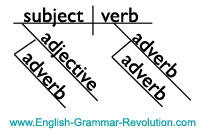
Adjectives and adverbs add color and description to our language. Adjectives modify (describe) nouns and pronouns. Adverbs modify verbs, adjectives, and other adverbs. In this chapter, you'll learn how to diagram adjectives and adverbs. Check it out!
Chapter 3: Prepositional Phrases
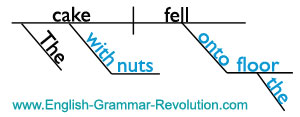
These little guys are hiding in just about every sentence that we read or write! Do you know what they are? Learning how to diagram them will help!
Chapter 4: Coordinating Conjunctions
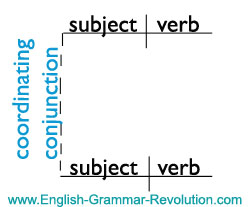
Conjunctions glue sentence elements together. Coordinating conjunctions join words, phrases, and independent clauses. It will be easy to SEE that when you learn how they are diagrammed. Seriously.
Chapter 5: Interjections
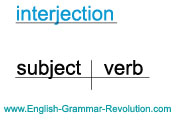
Yippee! Interjections are awesome! They are not grammatically related to the rest of the sentence, which is why they are set apart from the sentence in the diagram.
You'll also learn about nouns of direct address in this chapter.
Chapter 6: Types of Verbs - Part 1
Verbs do a lot in our language! In this chapter, you'll learn about transitive active verbs and their sidekicks: direct objects and indirect objects.

Chapter 7: Types of Verbs - Part 2
It's time to learn about transitive passive verbs and intransitive linking verbs.
In this lovely chapter of English grammar exercises, you will become a pro at identifying and diagramming these two verb types.
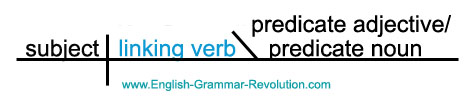
Chapter 8: Subordinating Conjunctions (Adverb Clauses)
Are you still with me? Great! In this chapter, you'll learn about subordinating conjunctions. They are words that join dependent adverb clauses to independent clauses.
Start Chapter 8: Diagramming Adverb Clauses (Subordinating Conjunctions)
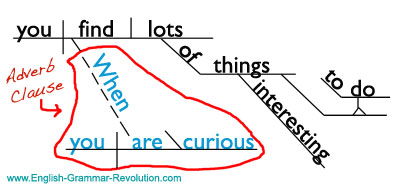
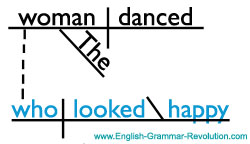
Chapter 9: Relative Pronouns (Adjective Clauses)
In this chapter, you'll learn about adjective clauses and the words that introduce them, relative pronouns and relative adverbs.
You can also call adjective clauses relative clauses if your little heart desires.
Start Chapter 9: Diagramming Adjective Clauses (Relative Pronouns)
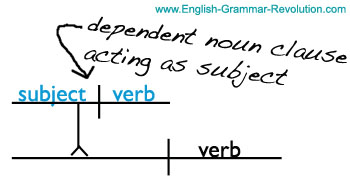
Chapter 10: Diagramming The Noun Clause
Noun clauses are dependent clauses that act as nouns. They can do anything that nouns can do. That means they can be subjects, direct objects, objects of prepositions, and more. It's time for you to learn more about them. Yay!
Chapter 11: Verbals
Verbals are formed from verbs, but they act as nouns, adjectives, and adverbs. There are three kinds of verbals and you'll learn about all of them in this final chapter of English grammar exercises!

Would you like to download these sentence diagramming exercises?
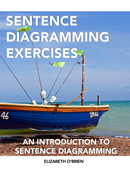

- 121 Pages
- Ebook, Instant Download
- Includes Instructions & Exercises For Diagramming Subjects, Verbs, Adjectives, Adverbs, Prepositional Phrases, Conjunctions, Interjections, Adverb Clauses, Adjective Clauses, Noun Clauses, Gerunds, Participles, & Infinitives
- Includes All Answers
- Printable
- 100% Money-Back Guarantee
- Only $19
Psst! This website allows you to diagram your sentences online.
I hope you had fun with these exercises!
This is original content from https://www.english-grammar-revolution.com/english-grammar-exercise.html

Hello! I'm Elizabeth O'Brien, and my goal is to get you jazzed about grammar.
I just bought your whole set of materials, and I'm thrilled! Your program has made my job a LOT easier!
I am using your materials with a young man (age 14), and your sentence diagramming program is just perfect for "filling in all the blanks" in grammar that he missed years ago.
He is responding like the champion, and I could not be more pleased.
- Jacquie, Tutor
Our Free Guide Gives You A Fun Way
To Teach And Learn The Basics v

Elizabeth O'Brien is the creator of Grammar Revolution.
Her lessons are guaranteed to give you more confidence in your communication skills and make you smile. :)
- Home
- How to Diagram



Home BLOG SHOP Contact PRIVACY POLICY Your Purchases
Copyright © 2009 - 2025 Grammar Revolution. All Rights Reserved.
JOIN OUR PRIVATE FACEBOOK GROUP RSS INSTAGRAM