Join the Smart Punctuation Challenge! We start February 23.
Diagramming Modifiers
Chapter 2: Adjectives & Adverbs
Diagramming Modifiers
Chapter 2: Adjectives & Adverbs
- Home
- How to Diagram
- Diagramming Modifiers (Adverbs & Adjectives)
Modifiers describe other words. Adjectives and adverbs are modifiers, and you'll learn more about them and how to diagram them with these exercises.
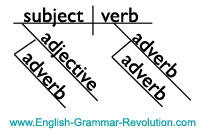
Sentence diagramming is a great way to SEE how the words in a sentence are related, and with these exercises, you'll be able to SEE how adjectives and adverbs describe other words.
There are five questions for each section. The answers are at the bottom of the page. Don't peek until you've tried them!
2.0 Diagramming Adjectives
Adjectives are words that describe nouns and pronouns. They answer the adjective questions. (Which one? What kind? How many? Whose?) Sentence diagrams show us that adjectives describe nouns and pronouns.
Directions: Diagram the following sentences by placing the adjectives on a slanted line under the word that they describe.
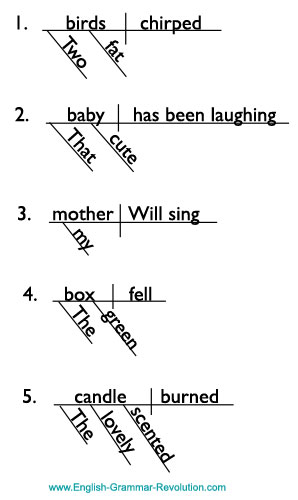
1. Two fat birds chirped.
2. That cute baby has been laughing.
3. Will my mother sing?
4. The green box fell.
5. The lovely, scented candle burned.
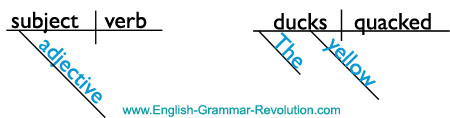
The yellow ducks quacked.
2.1 Diagramming Adverbs
Adverbs are words that describe verbs, adjectives, and other adverbs. They answer the adverb questions. (How? When? Where? Why? To what extent?) Sentence diagrams show us that adverbs describe verbs, adjectives and other adverbs.
Directions: Diagram the following sentences by placing the adverbs on a slanted line under the word that they describe.
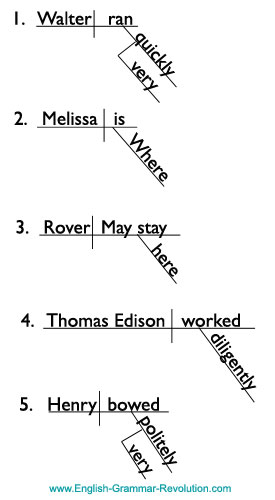
1. Walter ran very quickly.
2. Where is Melissa?
3. May Rover stay here?
4. Thomas Edison worked diligently.
5. Very politely, Henry bowed.
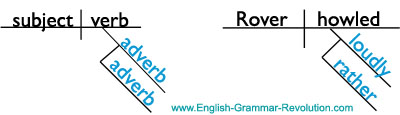
Rover howled rather loudly.
2.2 Diagramming Modifiers (Adjectives & Adverbs!)
It's time to put it all together.
Directions: Diagram the following sentences. These sentences have adjectives and adverbs.
1. The little red bird flew gracefully.
2. The rather large book was sitting here.
3. Where did that large cat go?
4. My very favorite aunt sings beautifully.
5. Who has been eating so noisily?
When adverbs modify adjectives, we put them on slanted lines under the adjectives that they modify.
2.0 Diagramming Adjectives Answers
2.1 Diagramming Adverbs Answers
2.2 Diagramming Modifiers (Adjectives & Adverbs!) Answers
Get these answers in the ebook!
Would you like to download these sentence diagramming exercises?

- 121 Pages
- Ebook, Instant Download
- Includes Instructions & Exercises For Diagramming Subjects, Verbs, Adjectives, Adverbs, Prepositional Phrases, Conjunctions, Interjections, Adverb Clauses, Adjective Clauses, Noun Clauses, Gerunds, Participles, & Infinitives
- Includes All Answers
- Printable
- 100% Money-Back Guarantee
- Only $19
>> Move On To Chapter 3: Diagramming Prepositional Phrases

This is original content from https://www.english-grammar-revolution.com/modifiers.html
Our Free Guide Gives You A Fun Way
To Teach And Learn The Basics v

Elizabeth O'Brien is the creator of Grammar Revolution.
Her lessons are guaranteed to give you more confidence in your communication skills and make you smile. :)
Other Helpful Resources
- Home
- How to Diagram
- Diagramming Modifiers (Adverbs & Adjectives)



Home BLOG SHOP Contact PRIVACY POLICY Your Purchases
Copyright © 2009 - 2026 Grammar Revolution. All Rights Reserved.