📘 Download your free grammar guide here. 📘
📘 Download your free grammar guide here. 📘
Present Simple Verb Tenses
Present Simple Verb Tenses
- Home
- Verb Tenses
- Simple Present Tense Verbs
Present simple verb tenses show actions that happen regularly or that are permanently happening.
The pretty horse gallops across the field.
Principal Parts of Verbs
You might be wondering what I'm talking about with this whole principal parts of a verb business.
I bring this up because it's very important, and it will help you to form the present simple verb tense.
All verbs can be broken down into four parts called the principal parts of a verb.
You form the present simple tense by using one of those principal parts - the present part. Let's look at a chart of the principal parts of a verb so that you know what I mean.
| Present | Present Participle | Past | Past Participle |
| come | (is) coming | came | (have) come |
| fall | (is) falling | fell | (have) fallen |
| go | (is) going | went | (have) gone |
| graduate | (is) graduating | graduated | (have) graduated |
| know | (is) knowing | knew | (have) known |
| walk | (is) walking | walk | (have) walked |
| write | (is) writing | wrote | (have) written |
Forming the Present Simple Tense
1. You use the verb's present form. 2. You add an s to the present form. 3. You add an es to the present form.
The verb itself and the number of the subject will determine which of the three ways you need to use. (It varies for each verb and subject.)
1. Use the present form of the verb.
You use this for plural subjects (that means more than one), and for those crazy singular pronouns I and you.I know how to make a sandwich.
2. Add s to present form of the verb.
You'll only do this when your subject is singular. (That means one.)The pretty horse gallops across the field.
3. Add es to the present form of the verb.
You'll only do this when your subject is singular and the verb ends in s, z, x, sh, or ch.The little girl misses her mom.
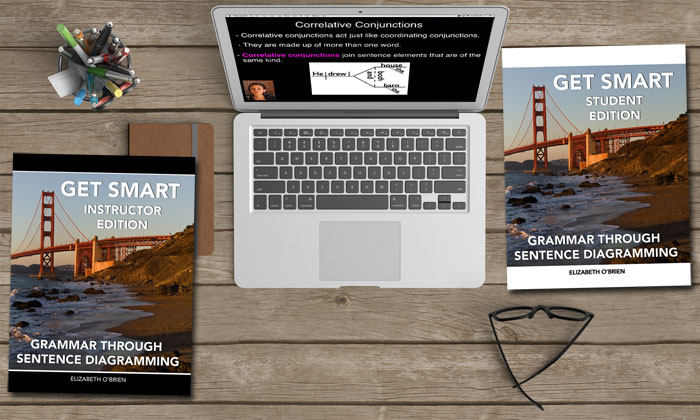
If you'd like to teach or learn grammar the easy way—with sentence diagrams—check out our Get Smart Grammar Program.
It starts from the very beginning and teaches you grammar and sentence diagramming in easy, bite-size lessons.

Hello! I'm Elizabeth O'Brien, and my goal is to get you jazzed about grammar.
I gave my regular ESL class yesterday, and I knew how to answer a question about dependent clauses and another about participles being used as adjectives. This was in my more advanced class. Hurray! Thanks.
- Lana, ESL Teacher
This is original content from https://www.english-grammar-revolution.com/present-simple.html
Our Free Guide Gives You A Fun Way
To Teach And Learn The Basics v

Elizabeth O'Brien is the creator of Grammar Revolution.
Her lessons are guaranteed to give you more confidence in your communication skills and make you smile. :)
- Home
- Verb Tenses
- Simple Present Tense Verbs



Home BLOG SHOP Contact PRIVACY POLICY Your Purchases
Copyright © 2009 - 2025 Grammar Revolution. All Rights Reserved.
JOIN OUR PRIVATE FACEBOOK GROUP RSS INSTAGRAM