📘 Download your free grammar guide here. 📘
📘 Download your free grammar guide here. 📘
Subject Verb Agreement
Subject Verb Agreement
- Home
- Usage & Rules
- Subject Verb Agreement
Subject-verb agreement refers to the number of the subject (whom or what a sentence is about) and verb (what the subject is or does).
You must use a singular subject with a singular verb and a plural subject with a plural verb. When this happens, we say that the subject and the verb agree. Isn't that nice?
In the example sentences below, the subjects are bold, and the verbs are underlined.
She is playing outside. (singular)
They are playing outside. (plural)
Mark runs on the track team. (singular)
The boys run on the track team. (plural)
If you're unsure what a plural verb looks like, know that many singular verbs end in s while the plural form of the verb doesn't, just like run/runs above. (However, that doesn't hold true for those tricky to be verbs).
Compound Subjects
Compound means two or more. The rule above is straightforward and easy to remember when you have one subject, but what happens when you have two or more subjects?
1. For singular compound subjects joined by and, use a plural verb.
My sister and brother walk to school.
2. For singular compound subjects joined by or or nor, use a singular verb.
A lamp or clock is in the box.
3. For plural compound subjects joined by or or nor, use a plural verb.
Neither lamps nor clocks are in the box.
4. For compound subjects that are both singular and plural joined by or or nor, use the verb that agrees with the closest subject.
Neither Jennifer nor the boys are in the race.
Either the boys or Jennifer is in the race.
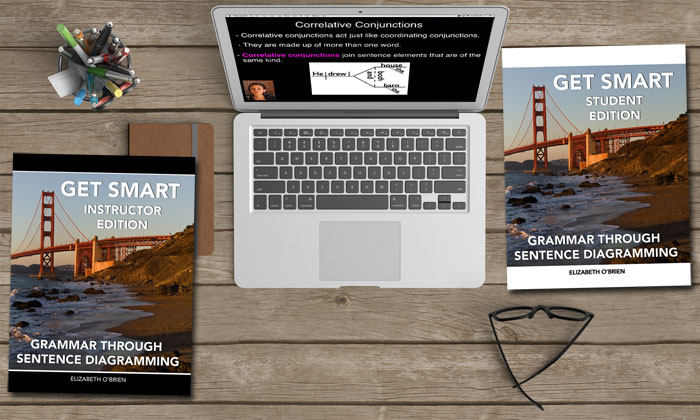
If you'd like to teach or learn grammar the easy way—with sentence diagrams—check out our Get Smart Grammar Program.
It starts from the very beginning and teaches you grammar and sentence diagramming in easy, bite-size lessons.

Hello! I'm Elizabeth O'Brien, and my goal is to get you jazzed about grammar.
I have spoken English all my life and never knew all of this. Thank you so much for your grammar courses. They are truly amazing!!!
- Minda

Our Free Guide Gives You A Fun Way
To Teach And Learn The Basics v

Elizabeth O'Brien is the creator of Grammar Revolution.
Her lessons are guaranteed to give you more confidence in your communication skills and make you smile. :)
Other Helpful Resources
- Home
- Usage & Rules
- Subject Verb Agreement



Home BLOG SHOP Contact PRIVACY POLICY Your Purchases
Copyright © 2009 - 2025 Grammar Revolution. All Rights Reserved.
JOIN OUR PRIVATE FACEBOOK GROUP RSS INSTAGRAM