📘 Download your free grammar guide here. 📘
📘 Download your free grammar guide here. 📘
Capitalization Rules
Capitalization Rules
- Home
- Usage & Rules
- Capitalization Rules
Use these capitalization rules to rule the world of capitalization!
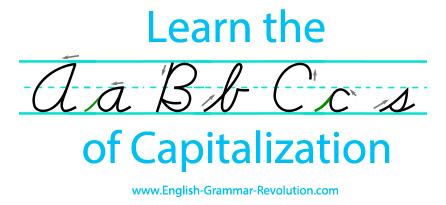
In most grammar books, you'll find pages and pages of capitalization rules.
I focused on the nitty-gritty here, and I've only given you six main rules and a few sub-rules to remember.
1. Capitalize Proper Nouns & Proper Adjectives
Proper nouns are nouns that name specific people, places, or things.
James, Paris, Colorado, Costa Rica
Proper adjectives are adjectives that are formed from proper nouns.
Proper Nouns: Spain, Ireland, Italy
Proper Adjectives: Spanish, Irish, Italian
Sometimes, it can be hard to know when a word is being used as a proper noun or not. Here are a few more tips that will help you.
- A. Capitalize words that show a family relationship when you use them with a person's name.
- Uncle Jack, Grandma Marge, Papa Phil
* Don't capitalize words that show a family relationship when you use them after a possessive pronoun.
my mother, his sister, our grandma
- B. Capitalize the names of school subjects only when you use them to refer to a specific course.
- I am excited to study history this summer.
I'll be taking History 101 at the community college.
* Always capitalize the names of languages.
I'd love to speak French, English, Spanish, Russian, and ChineseC. Capitalize the names of holidays, historical events, and periods.
- This Wednesday, we'll study World War II, and then we will watch the Cambrian Tennis Championship.
2. Capitalize the First Word in Every Sentence
That is one of the easiest capitalization rules to remember. The only trouble comes when you can't tell where one sentence ends and another begins.
Wrong -->
I would love to eat ice cream tonight because it is so yummy my favorite flavor is chocolate.
Right -->
I would love to eat ice cream tonight because it is so yummy. My favorite flavor is chocolate.
3. Capitalize the First Word in Direct Quotations
My sister asked, "Where are my shoes?"
- A. If the quotation is not meant to stand alone and is only a sentence fragment, you don't need to capitalize it.
- My sister claims that I "did not do the dishes correctly."
4. Capitalize the First and Last Words of Titles & Every Word Between Except Articles & Short, Unimportant Words
Wow. That was long. Do this for titles of books, poems, stories, movies, paintings, and magazines.
When the above rule says not to capitalize articles, it's referring to a specific kind of adjective called an article. The articles are a, an, and the.
Reader's Digest (magazine)
"I Wandered Lonely as a Cloud" (poem)
The Lord of the Rings (movie)
5. Capitalize Abbreviations of Titles & Organizations
Abbreviations are shortened forms of words or phrases.
I live in the U.S.A.
Today I will see Dr. Shriver.
This is my neighbor, Mr. Botts.
6. Capitalize the Pronoun I
That rule is short and sweet. Just remember that whenever you use this pronoun, you capitalize it. Note that this does not apply to any other pronoun.
I am going to buy oranges.
There are the six basic rules of capitalization!
Do you know when to capitalize the seasons (summer, winter, spring, fall) and directions (north, south, east, west)? Learn more about these two confusing capitalization rules here.
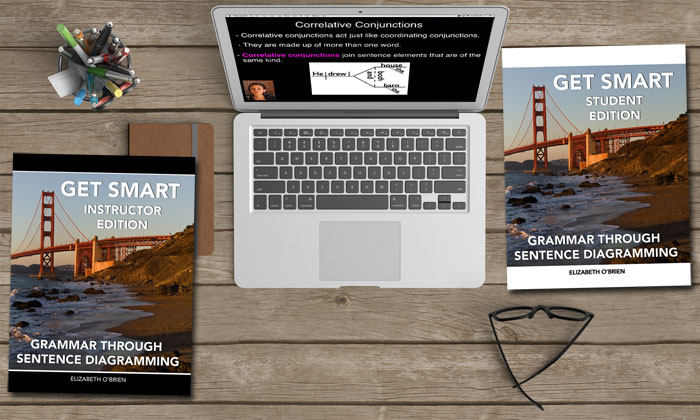
If you'd like to teach or learn grammar the easy way—with sentence diagrams—check out our Get Smart Grammar Program.
It starts from the very beginning and teaches you grammar and sentence diagramming in easy, bite-size lessons.

Hello! I'm Elizabeth O'Brien, and my goal is to get you jazzed about grammar.
We have been using Grammar Revolution for a few months now, and I just want to tell you how helpful it has been. Slowly but surely, we are getting our school to incorporate your program on a broader level; it will be exciting and helpful to say the least!
Thank you for the opportunity to make teaching grammar fun!
-Brooks, Teacher
This is original content from https://www.english-grammar-revolution.com/capitalization-rules.html
Our Free Guide Gives You A Fun Way
To Teach And Learn The Basics v

Elizabeth O'Brien is the creator of Grammar Revolution.
Her lessons are guaranteed to give you more confidence in your communication skills and make you smile. :)
- Home
- Usage & Rules
- Capitalization Rules



Home BLOG SHOP Contact PRIVACY POLICY Your Purchases
Copyright © 2009 - 2025 Grammar Revolution. All Rights Reserved.
JOIN OUR PRIVATE FACEBOOK GROUP RSS INSTAGRAM