📘 Download your free grammar guide here. 📘
📘 Download your free grammar guide here. 📘
What are gerunds and gerund phrases?
What are gerunds and gerund phrases?
Gerunds are words that are formed from verbs but act as nouns. You'll be able to spot them because they will be a verb + ing acting as a noun.
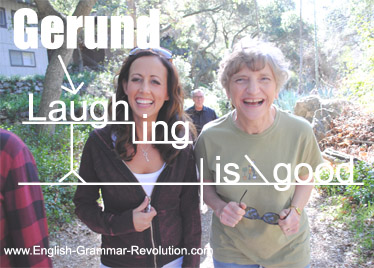
Laughing is good.
The word laugh is a verb. Laughing is a verb with an -ing ending acting as a noun. It is the subject of this sentence.
Tip: Words that are formed from verbs but don't act as verbs are called verbals. There are two other types of verbals: participles and infinitives.
They can do anything that nouns can do. That means that they can be subjects, direct objects, objects of prepositions, predicate nouns, and more!
Phrases
These consist of a gerund and the words that modify and complement it.
Swimming in the pool is fun.
Gerund |
Phrase |
| my favorite activity. |
|
Modifiers & Complements
Modifiers
You remember that these act as NOUNS, right? Of course you do.
You also remember that nouns are modified by adjectives, right? If you aren't comfortable with that yet, you should probably be reading up on the eight parts of speech.
Adjectives and adverbs are called modifiers because they modify (describe) other words.
Okay, let's get back to the matter at hand. Let's look at one of those examples from above.
Swimming in the pool is fun.
You may have noticed that in the pool is an adverbial prepositional phrase. It is telling us where the swimming happened.
(Where is one of the adverb questions.)
You should now be saying to yourself, "Hey! Nouns can only be modified by adjectives. What gives, Elizabeth?"
Here is what gives. ---> Gerunds are formed from verbs.
Even though they are officially nouns, they still carry some of the attributes of verbs.
Their "verbness" allows these guys to take adverbial modifiers just like any other verb - even though they act as nouns. (By the way, they can still take adjectival modifiers just like other nouns.)
Gerunds can even do other verby things...
Complements
Complements are things like direct objects. They complete verbs.
Guess what?
These babies can have complements!
Running marathons is my favorite activity.
Marathons is the direct object of running.
"Subjects"
Are you ready to hear something kind of strange? They can even have subjects... sort of.
Subjects are usually in the subject case (I, he, she), but these subjects will always be in the possessive case (his, her, my).
His snoring keeps me awake.
His is the "subject" of snoring.
In a Sentence... |
Acting As... |
Its Complement/Modifier... |
| Diagramming sentences is fun! | Subject | Sentences is the direct object of diagramming. |
| I love listening to my favorite band. | Direct Object | To my favorite band is a prepositional phrase modifying listening. |
| Mary's loud eating really bothers me! | Subject | Mary's is the "subject" of eating. Loud is an adverb modifying eating. |
Basic Sentence Diagramming
These sit on steps when you diagram them.
The verb part goes on the top part of the step, and on the -ing goes on the bottom part of the step.
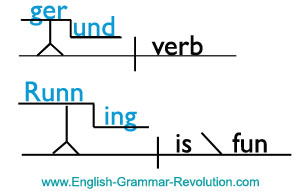
After that, you diagram the modifiers and complements just as you would with any other word.
If you'd like to teach or learn grammar the easy way—with sentence diagrams—check out our Get Smart Grammar Program.
It starts from the very beginning and teaches you grammar and sentence diagramming in easy, bite-size lessons.


Hello! I'm Elizabeth O'Brien, and my goal is to get you jazzed about grammar.
I am so glad I joined the Grammar Revolution. You bring spice to our English department!
- Eileen, Teacher
This is original content from https://www.english-grammar-revolution.com/gerunds.html
Our Free Guide Gives You A Fun Way
To Teach And Learn The Basics v

Elizabeth O'Brien is the creator of Grammar Revolution.
Her lessons are guaranteed to give you more confidence in your communication skills and make you smile. :)
Other Helpful Resources
- Test yourself with this worksheet. (It's a PDF.)



Home BLOG SHOP Contact PRIVACY POLICY Your Purchases
Copyright © 2009 - 2025 Grammar Revolution. All Rights Reserved.
JOIN OUR PRIVATE FACEBOOK GROUP RSS INSTAGRAM