📘 Download your free grammar guide here. 📘
📘 Download your free grammar guide here. 📘
What is an imperative sentence?
What is an imperative sentence?
- Home
- Sentence Types
- Imperative Sentences
An imperative sentence gives a command. It usually ends with a period, but it may also end with an exclamation point (!). Commands ask or tell people to do something.
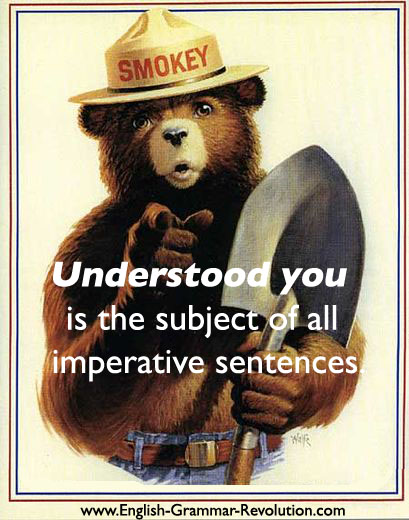
Please pass the salt.
Be there at 5:00.
Get out of my way!
Be careful.
All of those sentences can be categorized as commands.
Notice, though, that some of them don't sound as commanding as others. "Command" in this sense can also encompass requests, warnings, and invitations. These sentences just need to ask or tell someone to do something.
Finding the Subject of An Imperative Sentence
Subjects are nouns or pronouns that tell us whom or what a sentences is about. Here are some example sentences for you to check out. I've underlined the subjects for you.
The dog ran around the block.
Jimmy happily skipped to school.
Dog and Jimmy are the subjects of those sentences. They tell us whom or what the sentences are about.
Now, take a look at some imperative sentences.
Pass the salt.
Shut the door.
Smile.
What are the subjects of those sentences? Hmm... that's tricky!
The Subject Is (You)
This may sound strange, but every single command has the same subject! Yikes! How is that even possible?
Well, since commands are always speaking to someone or something (you've got to address them if you're going to ask them to do something), the subject is always the word you.
You may have noticed that the word "you" is not even in a command. Because of this, the subject is actually called you understood, and it is written like this: (you)
This means that the subject is the word you, but since you is not written or spoken in the sentence, it is simply understood and is written in parentheses.
| Imperative | Subject |
|---|---|
| Please find my yellow leotard. | (you) |
| Shut the door! | (you) |
| Be there at 5:00. | (you) |
When a command begins with a noun of direct address, you might get tricked into thinking that it is a declarative sentence.
Bob, shut the door!
Grandma, be there at 5:00.
But, don't get tricked! These sentences are still commands and their subjects are still (you). Learn more about nouns of direct address beginning commands here.
Diagramming Commands

Sentence diagrams show us how the words work in our sentences. We diagram the subject on the left and the verb on the right.
Here are some example diagrams for you! You can see that (you) is the subject of these sentences.

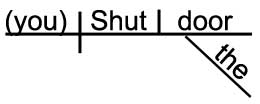
Shut the door.
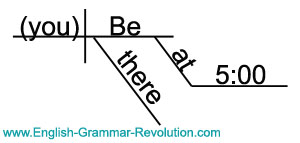
Be there at 5:00.
Have fun and learn more about diagramming with these exercises and these video lessons.
If you'd like to teach or learn grammar the easy way—with sentence diagrams—check out our Get Smart Grammar Program.
It starts from the very beginning and teaches you grammar and sentence diagramming in easy, bite-size lessons.


Hello! I'm Elizabeth O'Brien, and my goal is to get you jazzed about grammar.
We ordered all of your books, and we are loving them! My 12 year old son is racing through the lessons in the Get Smart program. He loves sentence diagramming. Thanks for making grammar fun and interesting.
- Denise, Homeschooler
This is original content from https://www.english-grammar-revolution.com/imperative-sentence.html

Our Free Guide Gives You A Fun Way
To Teach And Learn The Basics v

Elizabeth O'Brien is the creator of Grammar Revolution.
Her lessons are guaranteed to give you more confidence in your communication skills and make you smile. :)
Other Helpful Resources
- This PDF quizzes you on all four sentence types.
- Home
- Sentence Types
- Imperative Sentences



Home BLOG SHOP Contact PRIVACY POLICY Your Purchases
Copyright © 2009 - 2025 Grammar Revolution. All Rights Reserved.
JOIN OUR PRIVATE FACEBOOK GROUP RSS INSTAGRAM