Download your free grammar guide here.
Here's a list of pronouns!
Here's a list of pronouns!
- Home
- Word Lists
- List of Pronouns
Before you look at the list of pronouns, let's have a quick refresher on the definition of a pronoun.
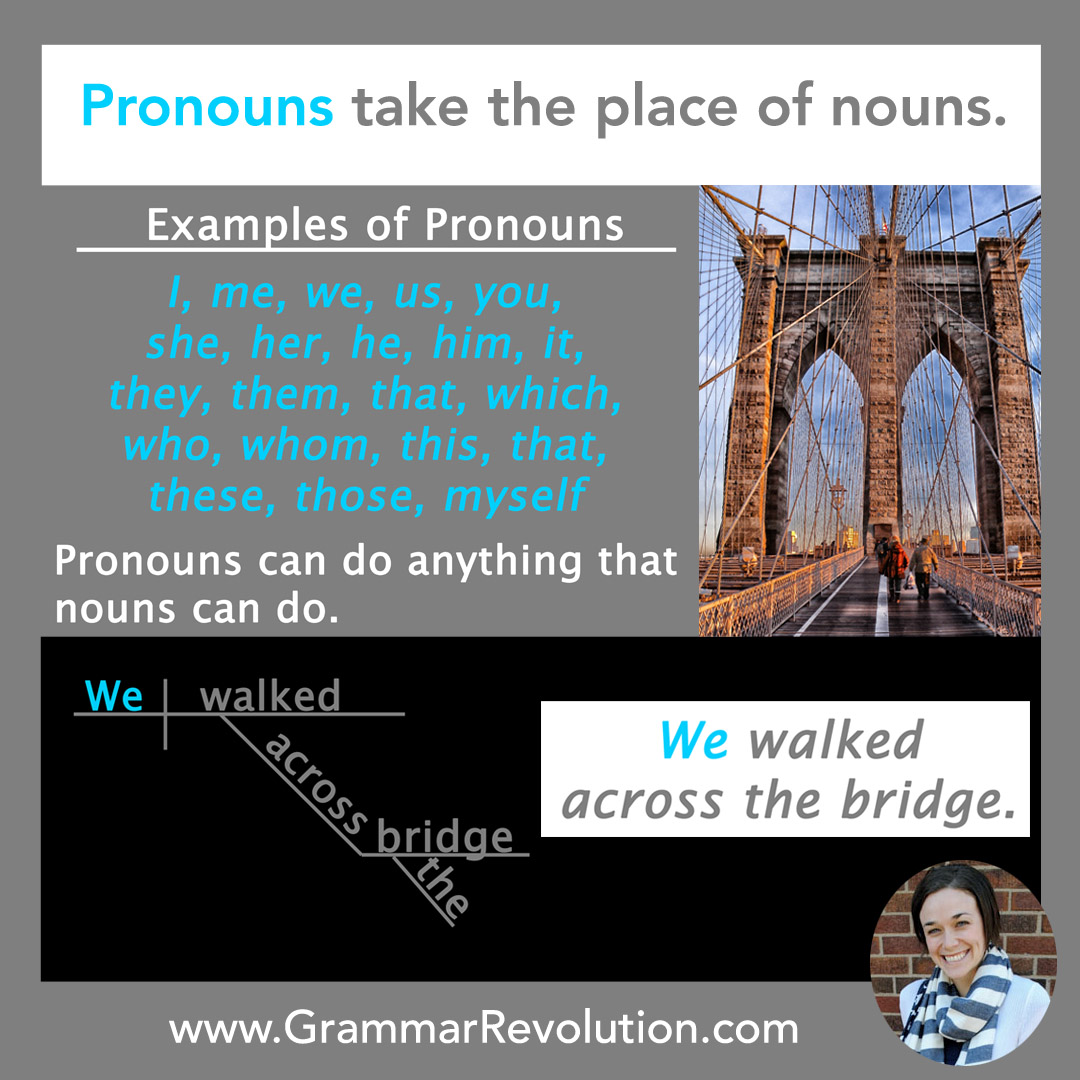
A pronoun is a word that takes the place of one or more nouns. If you want more information on these guys, check out the pronouns page.
The tables below show a list of pronouns for the following types of pronouns:
personal, relative, demonstrative, indefinite, reflexive,
intensive, interrogative, possessive, subject and object
Here's The List of Pronouns
Personal PronounsThese take the place of common and proper nouns. |
Singular | Plural |
| First Person: The person or people speaking or writing | I me |
we us |
| Second Person: The person or people being spoken or written to | you (Learn the story of you.) |
you |
| Third Person: The person, people, or things being spoken or written about | she, her he, him (they, them*) it |
they them |
* They/them are generally not singular pronouns, but keep in mind that some people use they/them as gender-neutral, singular pronouns.
Relative PronounsThese relate subordinate adjective clauses to the rest of the sentence. |
that, which, who, whom, whose, whichever, whoever, whomever |
Demonstrative PronounsThese represent a thing or things. |
Singular | Plural |
| Refers to things that are nearby | this | these |
| Refers to things that are far away | that | those |
Indefinite PronounsThese refer to something that is unspecified. |
|
| Singular | anybody, anyone, anything, each, either, everybody, everyone, everything, neither, nobody, no one, nothing, one, somebody, someone, something |
| Plural | both, few, many, several |
| Singular or Plural | all, any, most, none, some |
Reflexive PronounsThese end in -self or -selves. |
Singular | Plural |
| First Person: The person or people speaking or writing | myself (Do you misuse myself?) |
ourselves |
| Second Person: The person or people being spoken or written to | yourself | yourselves |
| Third Person: The person, people, or things being spoken or written about | himself, herself, itself | themselves |
Interrogative PronounsThese are used to ask questions. |
what, who, which, whom, whose |
Possessive PronounsThese are used to show ownership. |
Singular | Plural |
| Used Before Nouns These actually function as adjectives. Crazy! |
my your his, her, its |
our your their |
| Used Alone | mine yours his, hers |
ours yours theirs |
Subject and Object Pronouns |
Singular | Plural |
| Subjects tell us whom or what the sentence is about. | I you she, he, it |
we you they |
| Objects: direct objects, indirect objects, objects of prepositions | me you her, him, it |
us you them |
Would you like to download these word lists?
- Word Lists for the 8 Parts of Speech (Nouns, Pronouns, Verbs, Adjectives, Adverbs, Prepositions, Conjunctions, & Interjections)
- 17 Pages
- Printable
- 100% Money-Back Guarantee
- Only $2.99

Sentence Diagramming & Pronouns
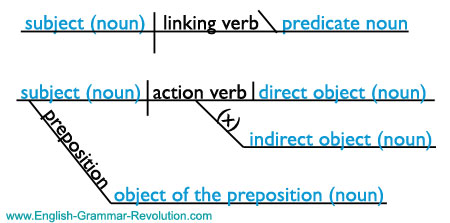
Sentence diagramming is a visual way to show how the words in a sentence are related to each other.
It's also really fun!

Hello! I'm Elizabeth O'Brien, and my goal is to get you jazzed about grammar.
Join my email list for grammar tips, diagramming fun, and updates about new lessons and resources.
Would you like to download these word lists?
Only $2.99
- Word Lists for the 8 Parts of Speech (Nouns, Pronouns, Verbs, Adjectives, Adverbs, Prepositions, Conjunctions, & Interjections)
- 17 Pages
- Printable
- 100% Money-Back Guarantee
I hope this has helped you learn a bit more about pronouns.
This is original content from https://www.english-grammar-revolution.com/list-of-pronouns.html
Our Free Guide Gives You A Fun Way
To Teach And Learn The Basics v

Elizabeth O'Brien is the creator of Grammar Revolution.
Her lessons are guaranteed to give you more confidence in your communication skills and make you smile. :)
Other Helpful Resources
- Soft School's Alphabetical List of Pronouns (Web Page)
- Home
- Word Lists
- List of Pronouns



Home BLOG SHOP Contact PRIVACY POLICY Your Purchases
Copyright © 2009 - 2026 Grammar Revolution. All Rights Reserved.