📘 Download your free grammar guide here. 📘
📘 Download your free grammar guide here. 📘
Reflexive Pronouns & Intensive Pronouns
Reflexive Pronouns & Intensive Pronouns
- Home
- Parts of Speech
- Pronouns
- Intensive & Reflexive Pronouns
Reflexive pronouns and intensive pronouns are kind of like identical twins. They look the same, but they're actually different. Both of them end in -self or -selves
myself, yourself, himself, herself, itself
ourselves, yourselves, themselves
So, what is the difference between these two pronouns? Let's explore that fascinating question!
What are reflexive pronouns?
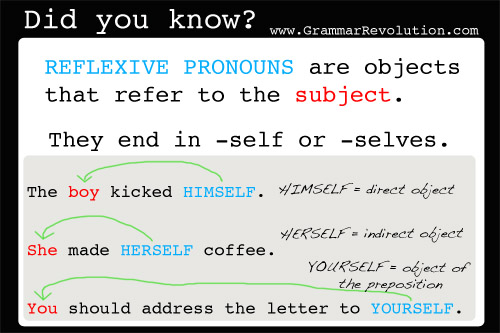
These pronouns are objects that are used to refer to the subject of the sentence. They are a necessary part of the sentence.
I made myself a sandwich.
Myself is referring to the subject which is I.
My sister and I bought ourselves popcorn at the movie.
Ourselves is referring to the subjects which, in this sentence, are the words sister and I.
Notice that these pronouns must be used with an antecedent. An antecedent is the word that a pronoun is referring to.
Since these pronouns always refer to the subject of the sentence, their antecedents will always be the subject.
Got it? Good! Now, it's time for intensive pronouns.
What are intensive pronouns?
Intensive pronouns are used to emphasize another noun or pronoun. They are also called emphatic appositives.
That means that they do not need to refer to the subject. They can refer to any old noun or pronoun in the sentence.
I made a sandwich for the President himself.
The intensive pronoun himself is referring to the noun President which is an object of the preposition.
My sister herself paid for my popcorn.
Here, the intensive pronoun herself is referring to sister which is the subject of the sentence. Notice that you could take herself out of the sentence, and it would still make sense.
Since an intensive pronoun is used for emphasis, it is not necessary to the sentence. It does not give us any new information.
You could take out an intensive pronoun from a sentence, and the sentence would still make sense.
Do not use MYSELF as a subject.

Sometimes, people think that myself "sounds" better than I when used as the subject. I can tell you with complete certainty that you should never use myself as a subject. Just don't do it, folks.
Note that you can use the intensive pronoun myself after you've already said I. That's legit. But it can't be used all alone as the subject.
If you'd like to teach or learn grammar the easy way—with sentence diagrams—check out our Get Smart Grammar Program.
It starts from the very beginning and teaches you grammar and sentence diagramming in easy, bite-size lessons.


Hello! I'm Elizabeth O'Brien, and my goal is to get you jazzed about grammar.
I graduated summa cum laude with a degree in English, but I didn't understand grammar until I took your program years later! My students, by the way, also adore your program!
- Michelle, Teacher
This is original content from https://www.english-grammar-revolution.com/reflexive-pronouns.html

Our Free Guide Gives You A Fun Way
To Teach And Learn The Basics v

Elizabeth O'Brien is the creator of Grammar Revolution.
Her lessons are guaranteed to give you more confidence in your communication skills and make you smile. :)
Other Helpful Resources
- Home
- Parts of Speech
- Pronouns
- Intensive & Reflexive Pronouns



Home BLOG SHOP Contact PRIVACY POLICY Your Purchases
Copyright © 2009 - 2025 Grammar Revolution. All Rights Reserved.
JOIN OUR PRIVATE FACEBOOK GROUP RSS INSTAGRAM