Download your free grammar guide here.
What is a subordinate clause?
What is a subordinate clause?
Are you ready to learn about the subordinate clause (a.k.a. dependent clause)? Great! You're in the right place.
Before we can get to what a dependent clause is, we need to review what a clause is.
What is a clause?
A clause is a group of words with a subject and a verb. That's it!
Subjects tell us whom or what a sentence is about, and verbs tell us what the subject is or does.
I sharpened my pencil.
Whenever I sharpened my pencil
Both of those groups of words are clauses. They have a subject (I) and a verb (sharpened). The top clause can stand alone as a complete idea, but the bottom clause cannot.
The bottom clause is subordinate. Subordinate means that it can't stand alone. It needs to be connected to an independent clause in order to make sense.
A subordinate clause is a group of words with a subject and a verb, that cannot stand alone.
Here's the important thing to know about these guys. Are you ready?
They act as single parts of speech.
You probably read over that last sentence kind of fast. You should read it again because it's SUPER IMPORTANT. Here, I'll even write it out again for you:
They act as single parts of speech.
What does that mean? That means that all of the words come together to perform the job of one part of speech. They can act as adjectives, adverbs, or nouns.
The Three Types of Subordinate Clauses
Dependent clauses can function as three different parts of speech: adjectives, adverbs, or nouns.
We'll go over each one below. Here we go!
1. Adjective Clauses (Relative Clauses)
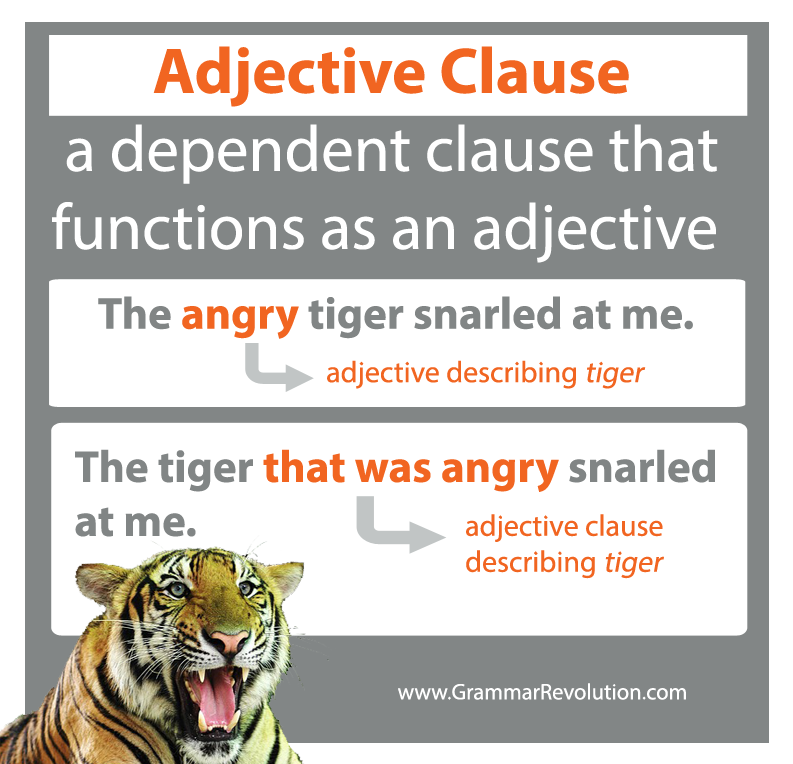
As you might guess, an adjective clause is a dependent clause that acts as an adjective. They are introduced by special words called relative pronouns or relative adverbs.
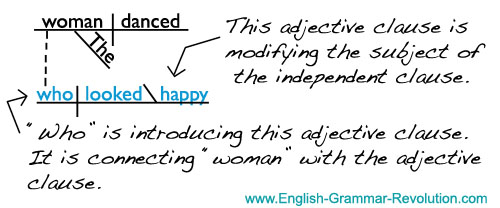
The woman who looked happy danced.
Who looked happy is a dependent adjective clause.
It is a group of words with a subject (who) and a verb (looked), and the whole clause is functioning as an adjective modifying the noun woman, which is the subject of the independent clause.
2. Adverb Clauses
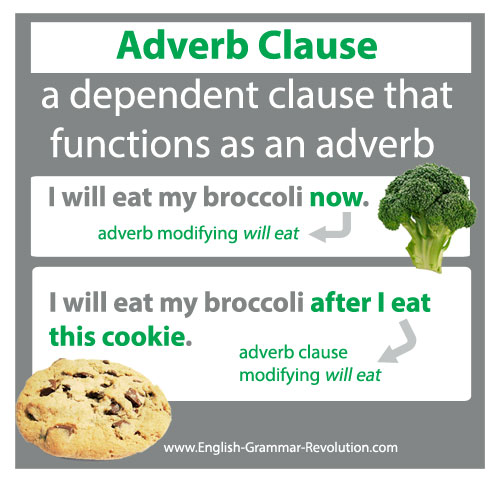
An adverb clause is a dependent clause that acts as an adverb. These are introduced by special words called subordinating conjunctions.
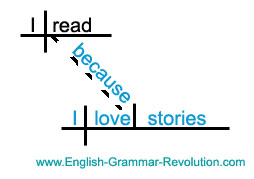
I read because I love stories.
Because I love stories is a dependent adverb clause. It has a subject (I) and a verb (love), and the whole clause is functioning as one adverb modifying the verb read in the independent clause.
Psst! Elliptical clauses are types of clauses that have some implied words. Most of the time, they are adverb clauses.
David is faster than his brother.
Than his brother is an elliptical clause. It's as if the clause says...
David is faster than his brother (is) (fast).
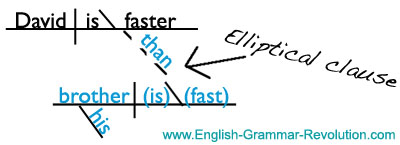
Than his brother (is) (fast) is a dependent adverbial elliptical clause. Wow! That's a mouthful!
It is a group of words with a subject (brother) and a verb (is), and the whole clause is acting as an adverb modifying the adjective faster in the independent clause.
3. Noun Clauses
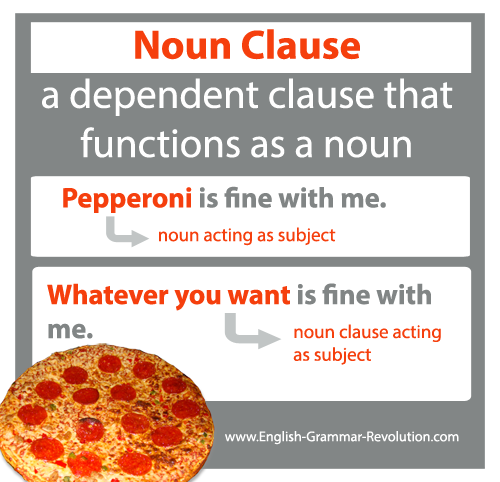
A noun clause is a dependent clause that acts as a noun.
Sometimes, these are introduced by certain kinds of words called noun clause markers, and sometimes they don't have any introductory word at all.
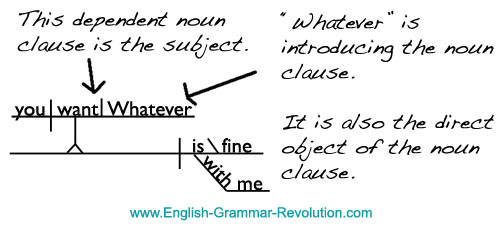
Whatever you want is fine with me.
Whatever you want is a dependent noun clause acting as the subject of the sentence. It is a group of words with a subject (you) and a verb (want), and it is functioning as a noun. It is performing the job of the subject.
If you'd like to teach or learn grammar the easy way—with sentence diagrams—check out our Get Smart Grammar Program.
It starts from the very beginning and teaches you grammar and sentence diagramming in easy, bite-sized lessons.
This is original content from https://www.english-grammar-revolution.com/subordinate-clause.html

Hello! I'm Elizabeth O'Brien, and my goal is to get you jazzed about grammar.
Join my email list for grammar tips, diagramming fun, and updates about new lessons and resources.
There you go. Now you know all about dependent clauses!
Our Free Guide Gives You A Fun Way
To Teach And Learn The Basics v

Elizabeth O'Brien is the creator of Grammar Revolution.
Her lessons are guaranteed to give you more confidence in your communication skills and make you smile. :)



Home BLOG SHOP Contact PRIVACY POLICY Your Purchases
Copyright © 2009 - 2026 Grammar Revolution. All Rights Reserved.