Download your free grammar guide here.
Download your free grammar guide here.
What is a preposition?
What is a preposition?
- Home
- Parts of Speech
- Prepositions
What is a preposition? I'll teach you!
Sometimes it helps to start with examples and pictures.
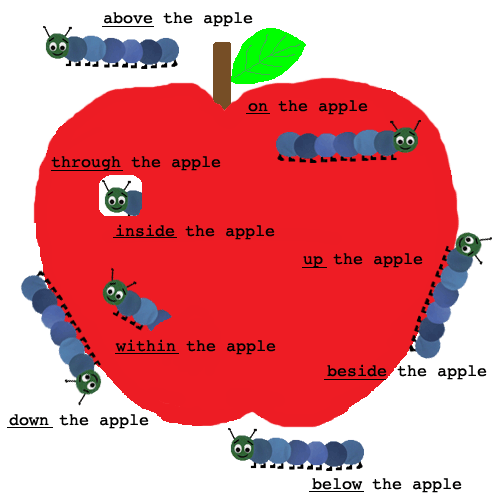
Think of a preposition as any word that describes the relationship between a caterpillar and an apple.
In this picture, all of the prepositions are underlined.
Are you ready to hear the actual definition of a preposition?
Brace yourself. This will sound complicated, but with the help of examples and a little more of an explanation, you'll know exactly what these little babies are.
Prepositions are words that show the relationship between a noun or
a pronoun and some other word or element in the rest of the sentence.
After reading that, you know exactly what a preposition is, right? Okay, maybe that's a little much to wrap your head around. Let's break that down with a few examples.
She swam across the lake.
Across connects the noun lake with the verb swam. It tells us where she swam. Do you see how the preposition tells us the relationship between lake and swam?
The cupcake with sprinkles is mine.
In this example, the preposition with is showing the relationship between the noun sprinkles and the noun cupcake. It tells us which cupcake is hers.
Is this still confusing? Are you still asking yourself, "So... what is a preposition?"
Let's look at a sentence diagram, shall we?
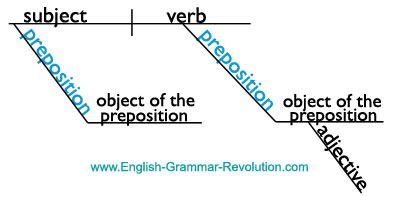
Sentence diagrams show us how the parts of sentences are related. You can see in the sentence diagram above that prepositions hook nouns (called objects of the preposition) to the rest of the sentence. You'll learn more about this below!
Prepositional Phrases
One ultra-important thing that you need to know about prepositions is that they are always in prepositional phrases.
- A phrase is a group of words, without both a subject and a verb, that functions as a single part of speech.
- A prepositional phrase consists of a preposition plus a noun or pronoun (the object of the preposition).
Object of the preposition is just a fancy name for the noun or pronoun that follows the preposition. In our apple example above, apple is the object of all of the prepositions. It is the first noun listed after each preposition.
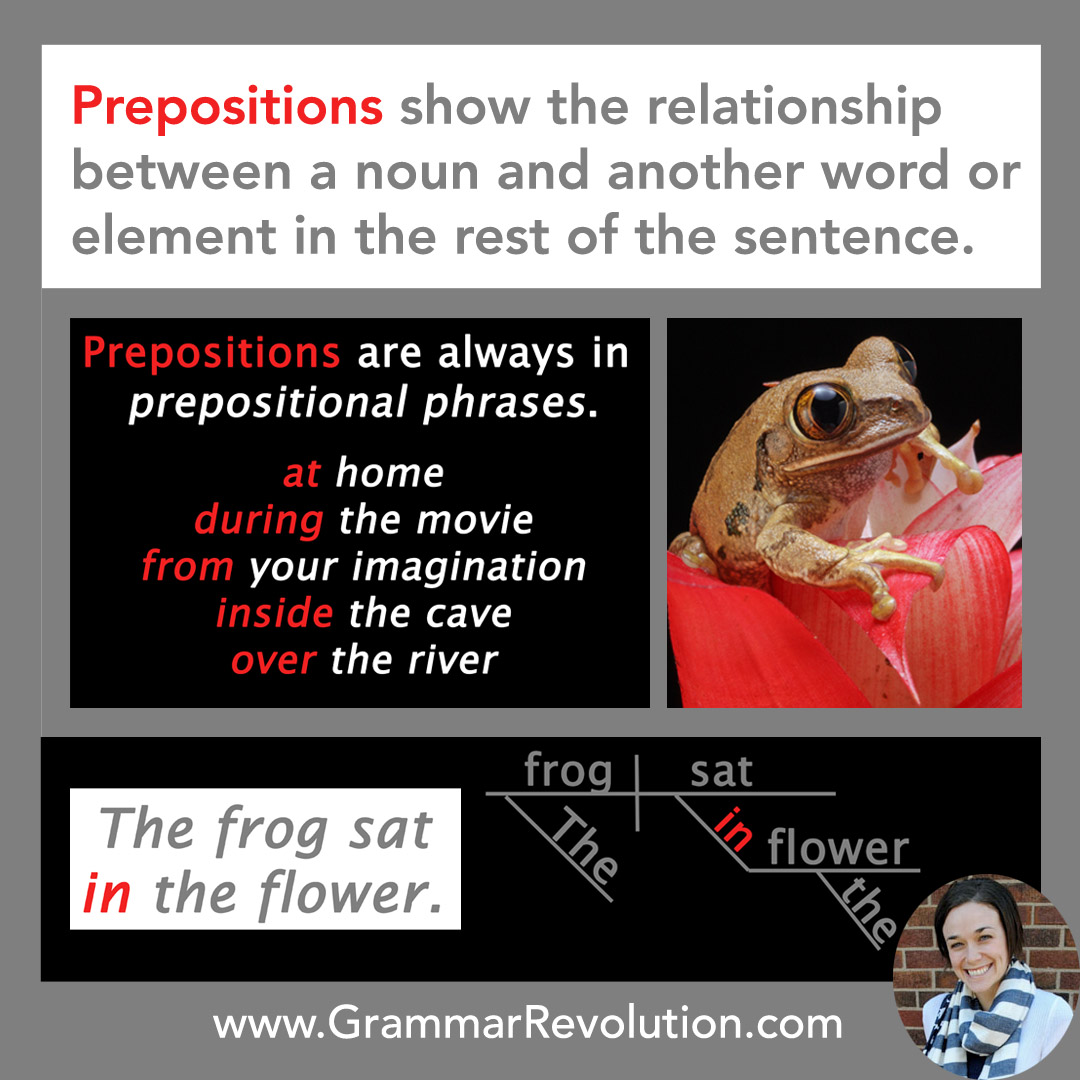
What's in a prepositional phrase?
Just like cheese and a tortilla are the minimum ingredients for a quesadilla, a preposition and an object of the preposition are the minimum ingredients for a prepositional phrase. And, just as we can jazz up a quesadilla by adding some chicken, salsa, or sour cream, we can jazz up prepositional phrases by adding adjectives and adverbs.
These prepositional phrases include only the necessary ingredients (preposition + object of the preposition).
with nuts
near water
with food
These prepositional phrases start with prepositions and end with nouns, but they also contain adjectives and/or adverbs.
above such foolishness
onto the floor
up the very steep mountain
Check out this sentence diagram! The prepositional phrases are in blue.
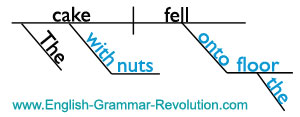
The cake with nuts fell onto the floor.
If you're hungry for more information on prepositional phrases (And who isn't?), I wrote another page all about prepositional phrases just for you!
Prepositional Phrases Act As Adjectives or Adverbs
What is a preposition? Do you remember? It's a word that shows the relationship between a noun or a pronoun and some other word or element in the rest of the sentence. Prepositions are always in prepositional phrases.
All of the words in a prepositional phrase come together to function as an adjective or adverb. (Sometimes they do other things, but we won't worry about that here!)
Prepositional Phrases Acting As Adjectives
If the prepositional phrase is describing a noun, the phrase is functioning as an adjective. (Adjectives modify nouns and pronouns.)
The table with the broken leg is downstairs.
Since the prepositional phrase with the broken leg is modifying table (a noun), this prepositional phrase is functioning as an adjective.
Prepositional Phrases Acting As Adverbs
If the prepositional phrase is describing a verb, adverb, or an adjective, then it's functioning as an adverb. (Adverbs modify verbs, adjectives, and other adverbs.)
The rabbit hopped through the pretty garden.
Through the pretty garden is a prepositional phrase modifying the verb hopped, so it's functioning as an adverb.

Preposition vs. Adverb
* This is important! *
When words from the preposition list are not used in prepositional phrases, they are NOT prepositions. I'll bet you can tell me why, right? Because prepositions are ALWAYS in prepositional phrases. Look at the word down in the following examples. Can you tell why one is a preposition and one is not?
A. The cat ran down the tree.
B. Put the ice cream down!
Will the real preposition please stand up?
I hope you guessed the preposition is in sentence A. In sentence A, the preposition down is in the prepositional phrase down the tree. In sentence B, down is not in a prepositional phrase, therefore, it is not a preposition. (In case you're wondering, it is an adverb, but don't worry about that yet.)
Phrasal Verbs
Sometimes, words from the preposition list are also used with verbs to form something called phrasal verbs (dress up, horse around, work out). In these cases, the words are NOT prepositions. Why? They are not performing the job of a preposition. In these cases, they are acting as part of the verb.
If you'd like to teach or learn grammar the easy way—with sentence diagrams—check out our Get Smart Grammar Program.
It starts from the very beginning and teaches you grammar and sentence diagramming in easy, bite-size lessons.

Hello! I'm Elizabeth O'Brien, and my goal is to get you jazzed about grammar.
What is a preposition? I hope that you can easily answer that now!
This is original content from https://www.english-grammar-revolution.com/what-is-a-preposition.html
Our Free Guide Gives You A Fun Way
To Teach And Learn The Basics v

Elizabeth O'Brien is the creator of Grammar Revolution.
Her lessons are guaranteed to give you more confidence in your communication skills and make you smile. :)
Other Helpful Resources
- Home
- Parts of Speech
- Prepositions



Home BLOG SHOP Contact PRIVACY POLICY Your Purchases
Copyright © 2009 - 2026 Grammar Revolution. All Rights Reserved.