📘 Download your free grammar guide here. 📘
📘 Download your free grammar guide here. 📘
What is an interjection?
What is an interjection?
- Home
- Parts of Speech
- Interjections
What is an interjection? How should you punctuate an interjection? My daughter, Alice, and I will teach you!
Do you know what the parts of speech are? They're categories for sorting our words. People usually divide all of the words that we use into eight or nine categories, and we call these the parts of speech. Interjections are one of these categories.
What is an interjection?
What makes interjections unique?
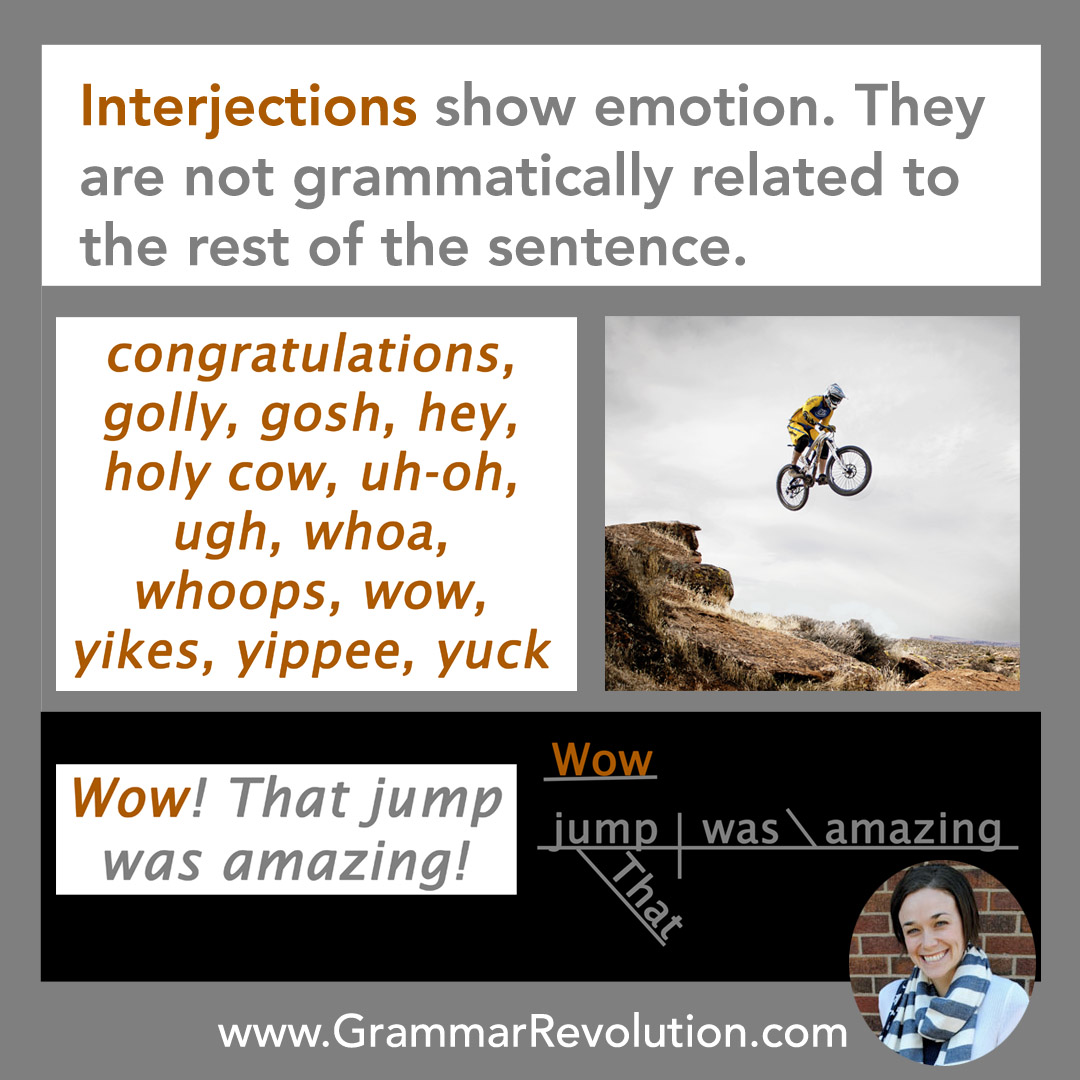
They're words that show emotion, and they're not grammatically connected to the rest of the sentence.
If a word has those traits, it's an interjection.
Something being "not grammatically connected to the rest of the sentence" is kind of a strange idea, so we'll go over what that means in just a minute. First, let's look at some examples to see how these guys show emotion.
- Happiness: Yippee! I found the keys!
- Nostalgia: Aw, this old photo is so sweet.
- Surprise: Oh no! One of the lenses in my glasses was just flushed down the toilet!* * inspired by actual events
- Excitement: Holy cow! I can't believe we won the game!
Look over those example sentences again, and see what else you can figure out about interjections. Ask yourself...
- Are they always one word?
- Where do they typically come in the sentence?
Since you're so smart, I'm sure that you were easily able to discover that interjections can be made up of more than one word, and they usually come at the beginning of a sentence. However, they can also be placed in the middle or at the end of sentences.
- Disgust: This cheese, eww, smells kind of funny.
- Relief: You arrived just in time. Phew!
Not Grammatically Related To The Other Words In The Sentence
You already read that interjections aren't grammatically related to the rest of the sentence, but what does that actually mean?
Well, it means that unlike all of the other parts of speech, interjections don't interact with any other words in the sentence.
- They don't modify anything (like adjectives and adverbs do).
- They can't be modified by anything (like nouns, pronouns, adjectives, adverbs, and verbs can).
- They don't connect any elements together (like conjunctions and prepositions do).
- They don't play a role in the main structure of sentences (like subjects and verbs do).
Interjections are very independent little things! In fact, you can see just how independent they are when we look at how to diagram them.
Diagramming sentences is a visual way to show how the words in a sentence are related to each other. If you've been looking around this site very much, you already know that I love diagramming sentences.
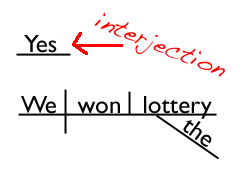
It's easy to see that interjections aren't grammatically related to the rest of the sentence because they float on lines hovering above the rest of the sentence! They're not joined to any other part of the sentence.
That's a pretty good way of showing that they aren't related to any of the other words, isn't it?
You can diagram more interjections here if you'd like.
How do you punctuate interjections?
I can tell that you're one smart cookie because you've already read this far. Because of that, I'm going to guess that you've already noticed the two marks that we can use to punctuate interjections: exclamation marks and commas.
Punctuate your interjections with an exclamation mark if the word is showing a strong emotion.
Wow! I won the lottery!
Use a comma if the emotion is not as strong.
Wow, I have a peanut butter sandwich for lunch.
Don't Get Fooled
Don't get fooled into thinking that all introductory words followed by an exclamation point or a comma are interjections. They're not!
Hmm... What is an interjection? Do you remember?
It's a word that shows emotion. So, if the word doesn't show emotion, it's probably not an interjection. Let's take a look.
Maria! Come and see the lion!
It's true that Maria comes at the beginning of the sentence, and it's not grammatically related to the rest of the sentence. However, names like this one are not interjections. They're nouns.
When you address someone by their name like this, it's called direct address.
Names also don't fit our definition of an interjection because they don't show emotion. The tone of voice that you say them in may show emotion, but the name itself does not.
Stop! The lion will eat you!
Stop isn't an interjection either. It's showing an action, so it's a verb. (It's also a complete sentence! This kind of sentence is called a command or an imperative sentence.)
Although the sentence as a whole does convey a sense of urgency (Who wants to get eaten by a lion?), the word stop isn't showing emotion.
If you'd like to see more examples of interjections, check out this list of interjections.
If you'd like to teach or learn grammar the easy way—with sentence diagrams—check out our Get Smart Grammar Program.
It starts from the very beginning and teaches you grammar and sentence diagramming in easy, bite-size lessons.

Hello! I'm Elizabeth O'Brien, and my goal is to get you jazzed about grammar.
I love and value your program! I teach at an all ELL secondary school and the video/visual has been invaluable for these students! Thank you for making this possible.
- Diane, Teacher
This is original content from https://www.english-grammar-revolution.com/what-is-an-interjection.html
I hope you liked this lesson on interjections!
Our Free Guide Gives You A Fun Way
To Teach And Learn The Basics v

Elizabeth O'Brien is the creator of Grammar Revolution.
Her lessons are guaranteed to give you more confidence in your communication skills and make you smile. :)
- Home
- Parts of Speech
- Interjections



Home BLOG SHOP Contact PRIVACY POLICY Your Purchases
Copyright © 2009 - 2025 Grammar Revolution. All Rights Reserved.
JOIN OUR PRIVATE FACEBOOK GROUP RSS INSTAGRAM