Join the Smart Punctuation Challenge! We start February 23.
Diagramming The Parts of Speech
Diagramming The Parts of Speech
- Home
- Sentence Diagramming Index
- Diagramming the Parts of Speech
On this page, you'll find out how to diagram each of the parts of speech. Click on the links below to learn more about each one.
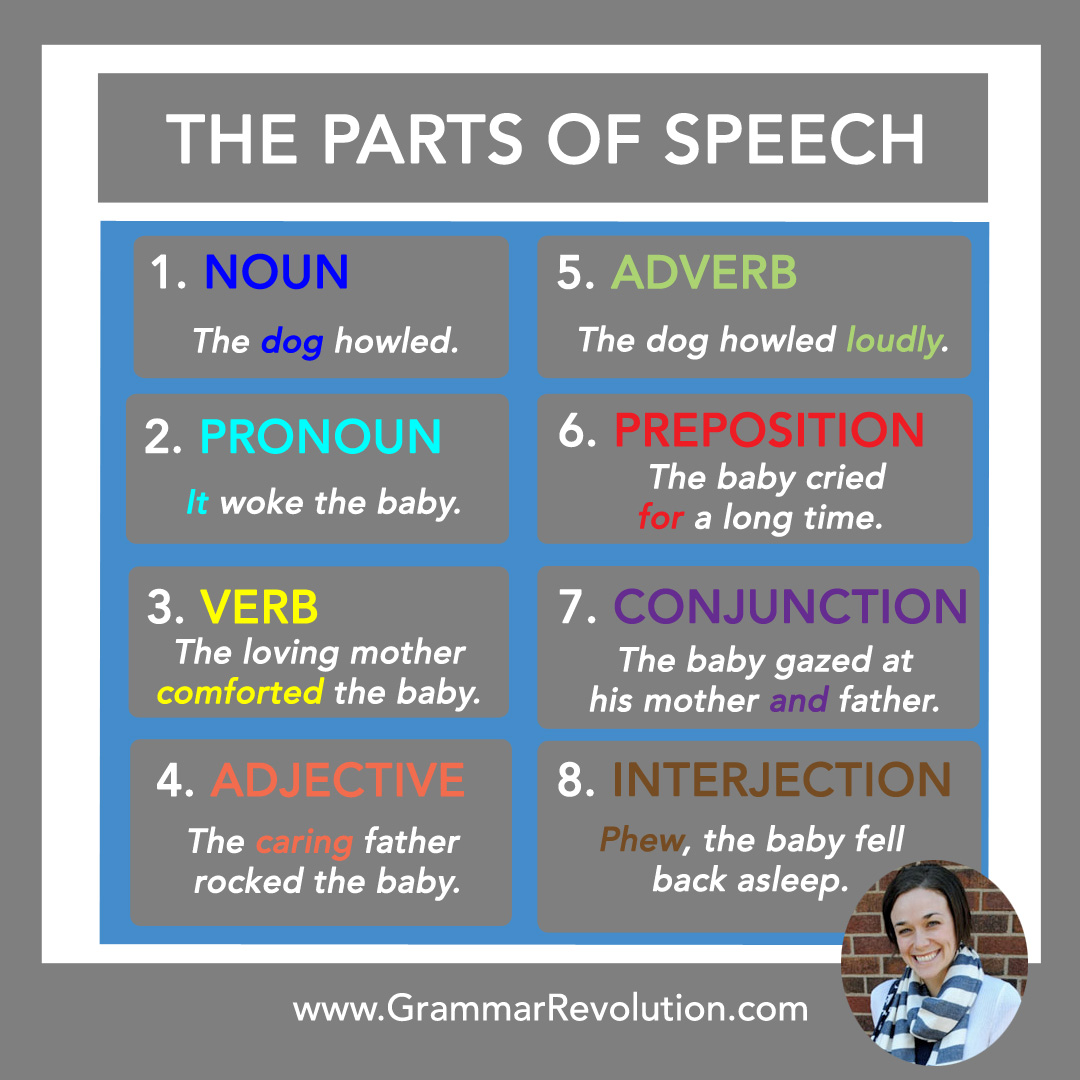
Nouns & Pronouns
Nouns name people, places, things, or ideas. Pronouns take the place of nouns.Nouns and pronouns can perform many jobs in sentences. They can be subjects, direct objects, indirect objects, objects of the preposition, predicate nouns, objective complements, and more!
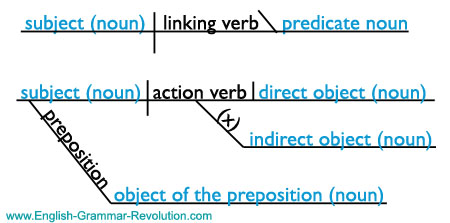
A predicate noun is a noun that comes after a linking verb and renames the subject.

An objective complement is a noun or an adjective that completes the direct object.

Back to Sentence Diagramming Index
Verbs
Don't you just love diagramming the parts of speech?Verbs name actions or states of being.
There are a few different types of verbs, and each type is diagrammed a little differently.
You can learn more about diagramming verbs on this page, but the diagram below will get you started!
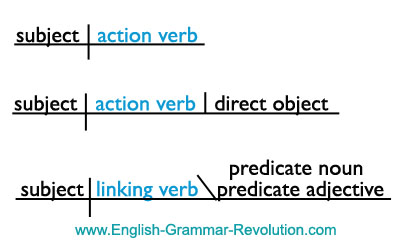
Learn more about diagramming transitive active verbs.
Learn more about diagramming transitive passive and intransitive linking verbs.
Back to Sentence Diagramming Index
Adjectives
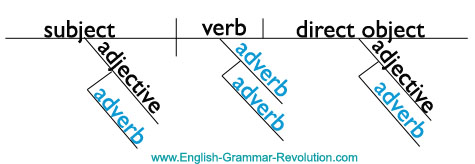
Adjectives describe nouns and pronouns.Since these describe nouns or pronouns, the line for them will always come from the noun or pronoun that they are describing.
Determiners are a type of adjective, so they are diagrammed just like other adjectives.
Learn more about diagramming adjectives.
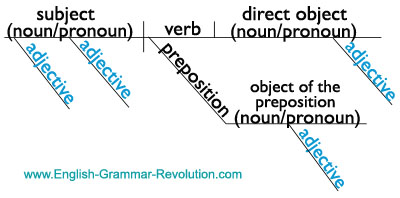
Adjectives can be predicate adjectives. Predicate adjectives come after linking verbs. They describe the subject.
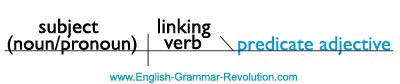
Adjectives (and nouns) can also be objective complements. These come after direct objects. They describe the direct object.
Back to Sentence Diagramming Index
Adverbs
Adverbs describe verbs, adjectives, and other adverbs.Since these describe verbs, adjectives, and other adverbs, the line for them will always come from the verb, adjective, or adverb that they are describing.
Learn more about diagramming adverbs.
Back to Sentence Diagramming Index
Prepositions
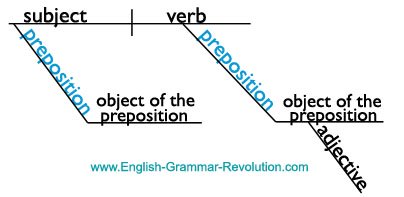
Prepositions are always found in prepositional phrases (a preposition + an object of the preposition).The whole phrase acts as either an adjective or an adverb. The preposition itself is diagrammed on a diagonal line coming from the word the phrase is modifying.
Learn more about diagramming prepositions.
Back to Sentence Diagramming Index
Conjunctions
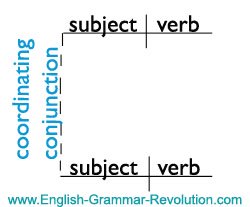
Conjunctions are connecting words.Coordinating conjunctions join elements that are the same. They are diagramed on dotted lines between the elements that they are connecting.
Learn more about diagramming coordinating conjunctions.
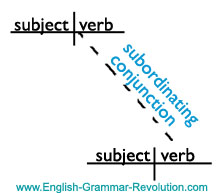
Subordinating conjunctions join dependent adverb clauses to independent clauses. They are diagramed on diagonal dotted lines between the elements that they are connecting.
Learn more about diagramming subordinating conjunctions.
Back to Sentence Diagramming Index
Interjections, Introductory Words, & Nouns of Direct Address
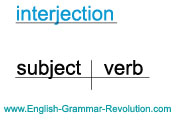
Both of these are not grammatically related to the rest of the sentence, and when we diagram them, it's very easy to see that they are not related to the rest of the sentence.They just float above the sentence on their own line!
Nouns of direct address and introductory words are diagrammed the same way as interjections.
Learn more about diagramming interjections.
Back to Sentence Diagramming Index
Miscellaneous: Appositives
Appositives are nouns that rename other nouns.Diagram them in parentheses after the noun that they are renaming.

Miscellaneous: Negatives
Negatives like not or n't are adverbs. Diagram them on a slanted line under the verb.If you have a contraction like isn't, put the verb is on the verb line and the adverb n't on the adverb line.


Hello! I'm Elizabeth O'Brien, and my goal is to get you jazzed about grammar.
Thank you for creating this product. It has been rewarding to enrich my understanding of English. I enjoy both the science and the challenge. I now look at grammar constructions like puzzles. It's cathartic.
- Ryan
Thank you!!! Thank you!!! Thank you!!! I'm 47 years old and have begun to understand grammar for the first time! I have a college degree and feel more comfortable, helping my 4 girls with school than ever before!
- Christine, Parent

Our Free Guide Gives You A Fun Way
To Teach And Learn The Basics v

Elizabeth O'Brien is the creator of Grammar Revolution.
Her lessons are guaranteed to give you more confidence in your communication skills and make you smile. :)
- Home
- Sentence Diagramming Index
- Diagramming the Parts of Speech



Home BLOG SHOP Contact PRIVACY POLICY Your Purchases
Copyright © 2009 - 2026 Grammar Revolution. All Rights Reserved.