📘 Download your free grammar guide here. 📘
📘 Download your free grammar guide here. 📘
What is an interrogative sentence?
What is an interrogative sentence?
- Home
- Sentence Types
- Interrogative Sentences
An interrogative sentence asks a question, and it always ends with a question mark. (It's basically just a fancy name for a question.)
One thing that people struggle with when it comes to questions is identifying the subject. The subjects of questions can be hard to find because they typically come after the verb or between parts of the verb phrase. (In other sentence types, the subject comes before the verb.)
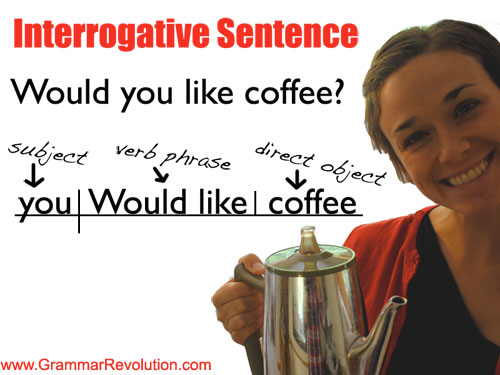
Would you like coffee?
Where are the brownies?
Did you buy eggs today?
Have you brushed your teeth yet?
Finding the Subject of An Interrogative Sentence
The good news is that you can rewrite questions in order to make the subjects easier to find! Yay!
How are you going to do this? You will change the question into a statement, and then the subject will be staring you in the face.
|
|
| Is your house ready for visitors? | Your house is ready for visitors. |
| Have you brushed your teeth today? | You have brushed your teeth today. |
| Is this your jacket? | This is your jacket. |
Strange But True
|
|
| Where is your house? | Your house is where. |
| When did you brush your teeth? | You did brush your teeth when. |
| How do I zip your jacket? | I do zip your jacket how. |
| Who is cooking the brownies? | Who is cooking the brownies. |
| What was your name? | What was your name. |
How To Diagram Questions
Sentence diagrams are a way for us to SHOW how the words in sentences are related. We show these relationships without using any punctuation. Because of this, you will not see the question mark in a diagram of a question!
All sentences must contain a subject and a verb. Check out the diagrams below. On the left, you'll see a basic diagram of a subject and a verb. On the right, you'll see a sentence diagram for the question below.

Have you been cooking?
If you'd like to learn more about the grammar of questions, click that link!
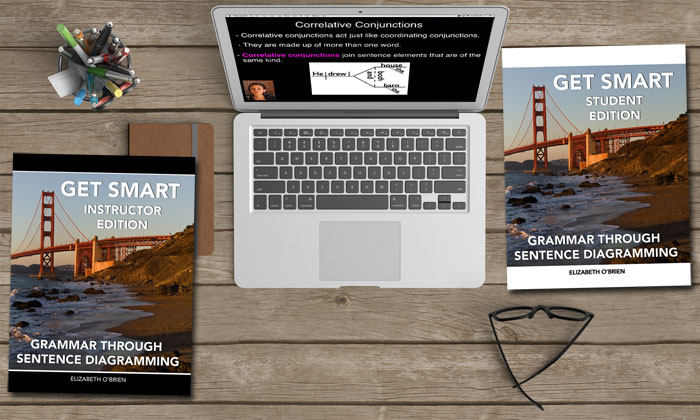
If you'd like to teach or learn grammar the easy way—with sentence diagrams—check out our Get Smart Grammar Program.
It starts from the very beginning and teaches you grammar and sentence diagramming in easy, bite-size lessons.

Hello! I'm Elizabeth O'Brien, and my goal is to get you jazzed about grammar.
I love your enthusiasm for this subject!
- Laura, Homeschooler
Thank you for an excellent program.
- Faith, Classroom Teacher
This is original content from https://www.english-grammar-revolution.com/interrogative-sentence.html
Our Free Guide Gives You A Fun Way
To Teach And Learn The Basics v

Elizabeth O'Brien is the creator of Grammar Revolution.
Her lessons are guaranteed to give you more confidence in your communication skills and make you smile. :)
- Home
- Sentence Types
- Interrogative Sentences



Home BLOG SHOP Contact PRIVACY POLICY Your Purchases
Copyright © 2009 - 2025 Grammar Revolution. All Rights Reserved.
JOIN OUR PRIVATE FACEBOOK GROUP RSS INSTAGRAM