Join the interactive Grammar & Writing Program! We start April 20.
Download your free grammar guide here.
Here's a list of verbs.
Here's a list of verbs.
- Home
- Word Lists
- List of Verbs
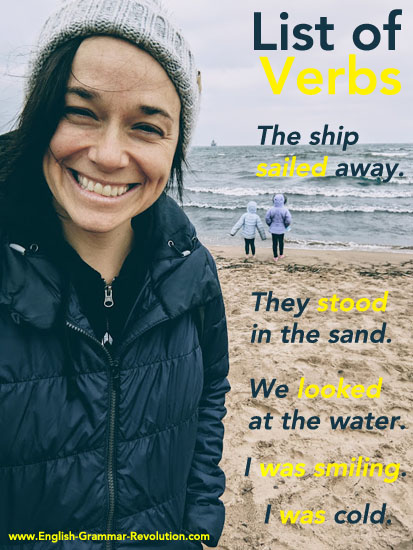
This list of verbs will help you understand verbs a little better. Do you remember that verbs are words that show actions or states of being? It's true!
There are two types of main verbs (action and linking), and there's one extra type that can help either of those main verbs. These helpers are called helping verbs.
On this page, we'll learn more about these verbs and see examples of all of them. Here we go!
Action Verbs
These are one of the types of main verbs. (Every sentence needs to have a subject and at least one main verb.) As their name implies, action verbs show action.
I walked around the lake.
We learned grammar.
Now it's your turn! Try thinking of three action verbs right now. Did you do it?
You probably picked verbs that showed movement that could be easily seen or heard (ran, jumped, shouted, skipped, cooked, wrote, etc.) That's great, but just keep in mind that there are many actions that can't be easily perceived with our eyes and ears (thought, contemplated, learned, etc.)
There are many, many action verbs out there, and we can further categorize them into three groups. Here are the three types of action verbs along with a list for each kind. Keep in mind that these lists aren't exhaustive.
List of Transitive Active Verbs
Transitive active verbs are action verbs that transfer their action to something called a direct object.
Joe kicked the ball.
Kicked is the transitive active action verb. It's transferring its action to ball, which is the direct object. Notice that ball is receiving the action. It's the thing that's getting kicked.
Transitive Active List
A accept, adopt, anticipate
B borrow, blame, buy
C carry, change, celebrate
D declare, develop, drive
E earn, edit, extend
F fix, forgive, forget
G gather, give, grip
H help, hug, hum
I identify, ignore, influence
J jerk, jog, juggle
K keep, kiss
L leak, lead, lift
M magnify, maintain, measure
N name, notice, nurture
O obliterate, offend, open
P pay, play, practice
Q question, quarantine
R rake, read, raise
S sing, steal, store
T teach, test, try
U unravel, unpack, use
V visit, volunteer, vote
W weigh, wrangle, write
X x-ray, xerox
Y yank, yell, yield
Z zest, zip
List of Transitive Passive Verbs
Transitive passive verbs are action verbs that transfer their action to the subject.
My car was stolen.
Stolen is the transitive passive verb (was is a helping verb). It is transferring its action to car, which is the subject. Notice that car is receiving the action. It's the thing that's getting stolen.
Transitive passive verbs are always in verb phrases, and they are always made with the past participle form of the verb.
Transitive Passive List
To create a transitive passive verb, add is, am, are, was, were, be, being, or been in front of the past participles listed below.
A accepted, adopted, anticipated
B borrowed, blamed, bought
C carried, changed, celebrated
D declared, developed, driven
E earned, edited, extended
F fixed, forgave, forgiven
G gathered, given, gripped
H helped, hugged, hummed
I identified, ignored, influenced
J jerked, jogged, juggled
K kept, kissed
L leaked, led, lifted
M magnified, maintained, measured
N named, noticed, nurtured
O obliterated, offended, opened
P paid, played, practiced
Q questioned, quarantined
R raked, read, raised
S sung, stolen, stored
T taught, tested, tried
U unraveled, unpacked, used
V visited, voted
W weighed, wrangled, written
X x-rayed, xeroxed
Y yanked, yelled, yielded
Z zested, zipped
Intransitive Complete
Intransitive complete verbs are action verbs that don't transfer their action to anyone or anything. They are complete all by themselves!
The dog barked.
Notice that the dog didn't bark something. It just barked. It's not transferring its action to a receiver.
Intransitive Complete List
A accelerated, acted, ate
B barked, biked, blinked
C changed, chewed, cooked
D dominated, drooled, drove
E endured, exercised
F fished, flashed, forgot
G grinned, grumbled, grunted
H helped, hid, hurried
I improved, invaded, investigated
J jaywalked, joked, jumped
K kayaked, kicked, kidded
L laughed, learned, looked
M migrated, moped
N navigated, nested
O observed, overpaid
P paid, painted, posed
Q quacked, quarreled, quipped
R ran, read, rose
S sang, shouted, swam
T testified, twisted, typed
U understood, unpacked, unwound
V volunteered, voted
W waddled, winked, worked
Y yawned, yelled, yodeled
Z zipped
Linking Verbs
You just learned that action verbs are one of the types of main verbs. Now, we'll look at the other kind: linking verbs. Linking verbs don't show action. They link the subject of a sentence with either a noun that renames it (called a predicate noun) or an adjective that describes it (called a predicate adjective).
You might find it helpful to think of linking verbs as equals signs between subjects and predicate nouns or predicate adjectives.
I am a teacher.
I = teacher
As you know, there are many, many action verbs. However, there are only a handful of verbs that can function as linking verbs. Here they are:
Linking Verbs List
be, am, is, are, was, were, been, being
appear, become, feel, grow, look, seem, remain, smell, sound, stay, taste, turn
Helping Verbs
You have just learned about the two types of main verbs: action verbs and linking verbs. It's time to learn about helping verbs!
These do just what their name implies. They help the main verb in the sentence by telling us more about its tense and the subtleties of its meaning. Remember that the main verb will be either an action verb or a linking verb.
The dog will bark.
Bark is the main verb. It's an action verb. Will is the helping verb.
The helping verb(s) and the main verb come together to form a verb phrase.
Danny will be an artist.
Be is the main verb. It's a linking verb. Will is the helping verb. Both words together (will be) form a verb phrase.
Here is a list of 24 common helping verbs. You can sing these to the tune of Witch Doctor ("Ooh ee ooh ah ah..."). I sing it for you here if you'd like to listen to me! :)
Helping Verbs List
be, am, is, are, was,
were, been, being, have, has, had,
could, should, would, may, might,
must, shall, can, will, do, did,
does, having
Would you like to download these word lists?

- Word Lists for the 8 Parts of Speech (Nouns, Pronouns, Verbs, Adjectives, Adverbs, Prepositions, Conjunctions, & Interjections)
- 17 Pages
- Printable
- 100% Money-Back Guarantee
- Only $2.99

This is original content from https://www.english-grammar-revolution.com/list-of-verbs.html

Hello! I'm Elizabeth O'Brien, and my goal is to get you jazzed about grammar.
Join my email list for grammar tips, diagramming fun, and updates about new lessons and resources.
Would you like to download these word lists?
Only $2.99
- Word Lists for the 8 Parts of Speech (Nouns, Pronouns, Verbs, Adjectives, Adverbs, Prepositions, Conjunctions, & Interjections)
- 17 Pages
- Printable
- 100% Money-Back Guarantee

Our Free Guide Gives You A Fun Way
To Teach And Learn The Basics v

Elizabeth O'Brien is the creator of Grammar Revolution.
Her lessons are guaranteed to give you more confidence in your communication skills and make you smile. :)
Other Helpful Resources
- Home
- Word Lists
- List of Verbs



Home BLOG SHOP Contact PRIVACY POLICY Your Purchases
Copyright © 2009 - 2026 Grammar Revolution. All Rights Reserved.