📘 Download your free grammar guide here. 📘
📘 Download your free grammar guide here. 📘
Here's a list of nouns.
Here's a list of nouns.
- Home
- Word Lists
- List of Nouns
The following list of nouns should help you understand nouns a little better. Remember that nouns are words that name people, places, things, or ideas.
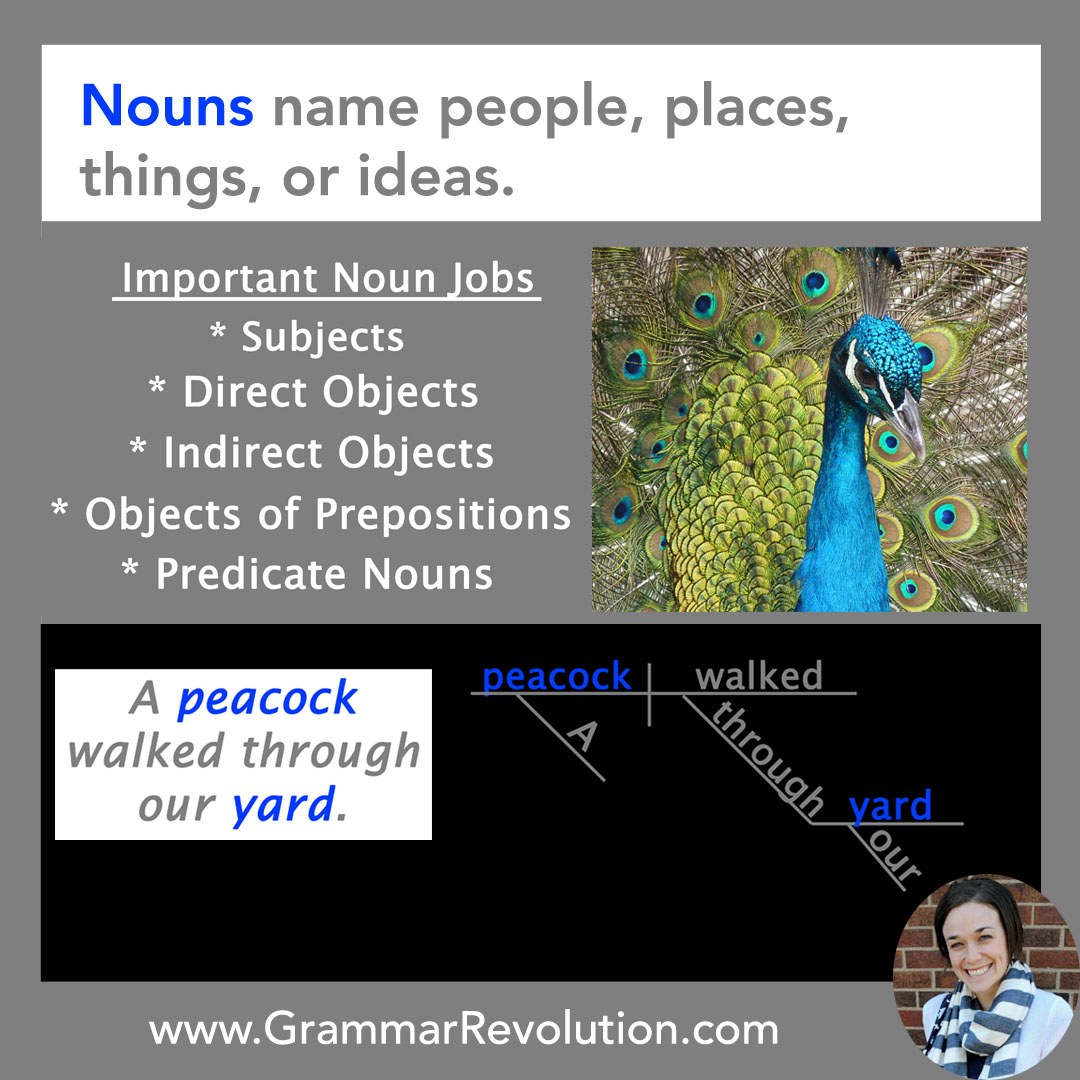
Before you look at the list, I'd like to point out that each noun fits into more than one of the categories below. For example, the word train is a common, concrete, countable, singular noun. Got it? Good!
List of Nouns
Noun Type |
Examples |
| Common Nouns name people, places, or things that are not specific. They are not capitalized unless they are in a place in the sentence that requires a capital letter (such as the first word in a sentence). | man, mountain, state, ocean, country, building, cat, airline |
| Proper Nouns name specific people, places, or things. They begin with a capital letter. | Walt Disney, Mount Kilimanjaro, Minnesota, Atlantic Ocean, Australia, Empire State Building, Fluffy, Sun Country |
| Concrete Nouns name nouns that you can perceive with your five senses. (Your five senses are the sense of sight, sound, taste, smell, and touch.) | house, ocean, Uncle Mike, bird, photograph, banana, eyes, light, sun, dog, suitcase, flowers |
| Abstract Nouns name nouns that you can't perceive with your five senses. | love, wealth, happiness, pride, fear, religion, belief, history, communication |
| Countable Nouns name nouns that you can count. These kinds of nouns can be singular or plural. | bed, cat, movie, train, country, book, phone, match, speaker, clock, pen, David, violin |
| Uncountable Nouns name nouns that you can't count. These kinds of nouns can't be made plural. | milk, rice, snow, rain, water, food, music, luggage |
| Compound Nouns are made up of two or more words. These words may have no space between them (closed compounds), a space between them (open compounds), or a hyphen between them (hyphenated compounds). | tablecloth, eyeglasses, New York, photograph, daughter-in-law, pigtails, sunlight, snowflake |
| Collective Nouns refer to things or people as a unit. You may treat these as singular nouns or plural nouns depending on what aspect of the noun you want to highlight. | bunch, audience, flock, team, group, family, band, village |
| Singular Nouns name one person, place, thing, or idea. | cat, sock, ship, hero, monkey, baby, match |
| Plural Nouns name more than one person, place, thing, or idea. They end with the letter -s. | cats, socks, ships, heroes, monkeys, babies, matches |
| Possessive Nouns show ownership, and we use apostrophes to create them. (They are strange because they actually function as adjectives!) | Mom's car, Beth's cat, the student's book |
Would you like to download these word lists?
- Word Lists for the 8 Parts of Speech (Nouns, Pronouns, Verbs, Adjectives, Adverbs, Prepositions, Conjunctions, & Interjections)
- 17 Pages
- Printable
- 100% Money-Back Guarantee
- Only $2.99

Nouns, Noun Jobs, & Sentence Diagrams
Seeing a list of nouns is a great way to learn what nouns are, but sentence diagramming can teach you what nouns do. Did you know that nouns perform many different jobs in our sentences? Below, you'll find sentence diagrams for seven of the noun jobs.
Are you wondering what a sentence diagram is? Sentence diagramming is a visual way to show how the words in a sentence are related to each other. Since nouns can do many things in a sentence, the way they are diagrammed depends on the way that they are acting in each sentence.
1. Nouns can be subjects.
Subjects tell us whom or what a sentence is about. Every sentence needs a subject.
The students happily studied grammar.
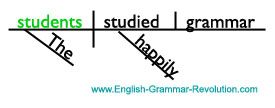
The noun students is in the subject slot of our sentence diagram.
2. Nouns can be direct objects.
Direct objects receive the action of transitive active verbs.
The students happily studied grammar.

The noun grammar is in the direct object slot of our sentence diagram.
3. Nouns can be indirect objects.
Indirect objects tell us to whom or for whom the action of the verb is done.
They taught their friends grammar.
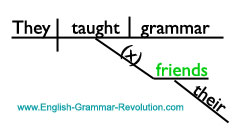
The noun friends is in the indirect object slot of the sentence diagram.
4. Nouns can be objects of prepositions.
Objects of prepositions are nouns that come after prepositions in prepositional phrases.
Their friends smiled with glee.
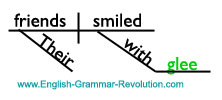
The noun glee is in the object of the preposition slot in the sentence diagram.
5. Nouns can be predicate nouns.
Predicate nouns are nouns that come after linking verbs. They rename the subject of the sentence.
They were grammar champions!
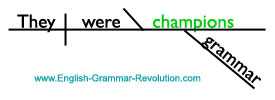
The noun champions is in the predicate noun slot of the sentence diagram.
6. Nouns can be objective complements.
Objective complements are nouns that complete the direct object.
They elected my uncle mayor.

The noun mayor is in the objective complement slot of the sentence diagram.
7. Nouns can be appositives.
Appositives are nouns that rename other nouns.
My friend Marianne likes cupcakes.
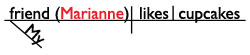
We diagram appositives in parentheses after the noun that the appositive is renaming. Since the noun Marianne is renaming the subject friend, it's in the subject slot of the sentence diagram.
How did that go? I hope that you found this list of nouns helpful!

Hello! I'm Elizabeth O'Brien, and my goal is to get you jazzed about grammar.
Would you like to download these word lists?
Only $2.99
- Word Lists for the 8 Parts of Speech (Nouns, Pronouns, Verbs, Adjectives, Adverbs, Prepositions, Conjunctions, & Interjections)
- 17 Pages
- Printable
- 100% Money-Back Guarantee
This is original content from https://www.english-grammar-revolution.com/list-of-nouns.html
Our Free Guide Gives You A Fun Way
To Teach And Learn The Basics v

Elizabeth O'Brien is the creator of Grammar Revolution.
Her lessons are guaranteed to give you more confidence in your communication skills and make you smile. :)
Other Helpful Resources
- The Top 1,500 Nouns Used in English (Web Page)
- Home
- Word Lists
- List of Nouns



Home BLOG SHOP Contact PRIVACY POLICY Your Purchases
Copyright © 2009 - 2025 Grammar Revolution. All Rights Reserved.
JOIN OUR PRIVATE FACEBOOK GROUP RSS INSTAGRAM