📘 Download your free grammar guide here. 📘
📘 Download your free grammar guide here. 📘
What is a pronoun?
What is a pronoun?
- Home
- Parts of Speech
- Pronouns
What is a pronoun? A pronoun is a word that takes the place of a noun.
Pronouns can do all of the things that nouns can do. They can be subjects, direct objects, indirect objects, object of the preposition, and more. Hey, the word pronoun even has the word noun in it!
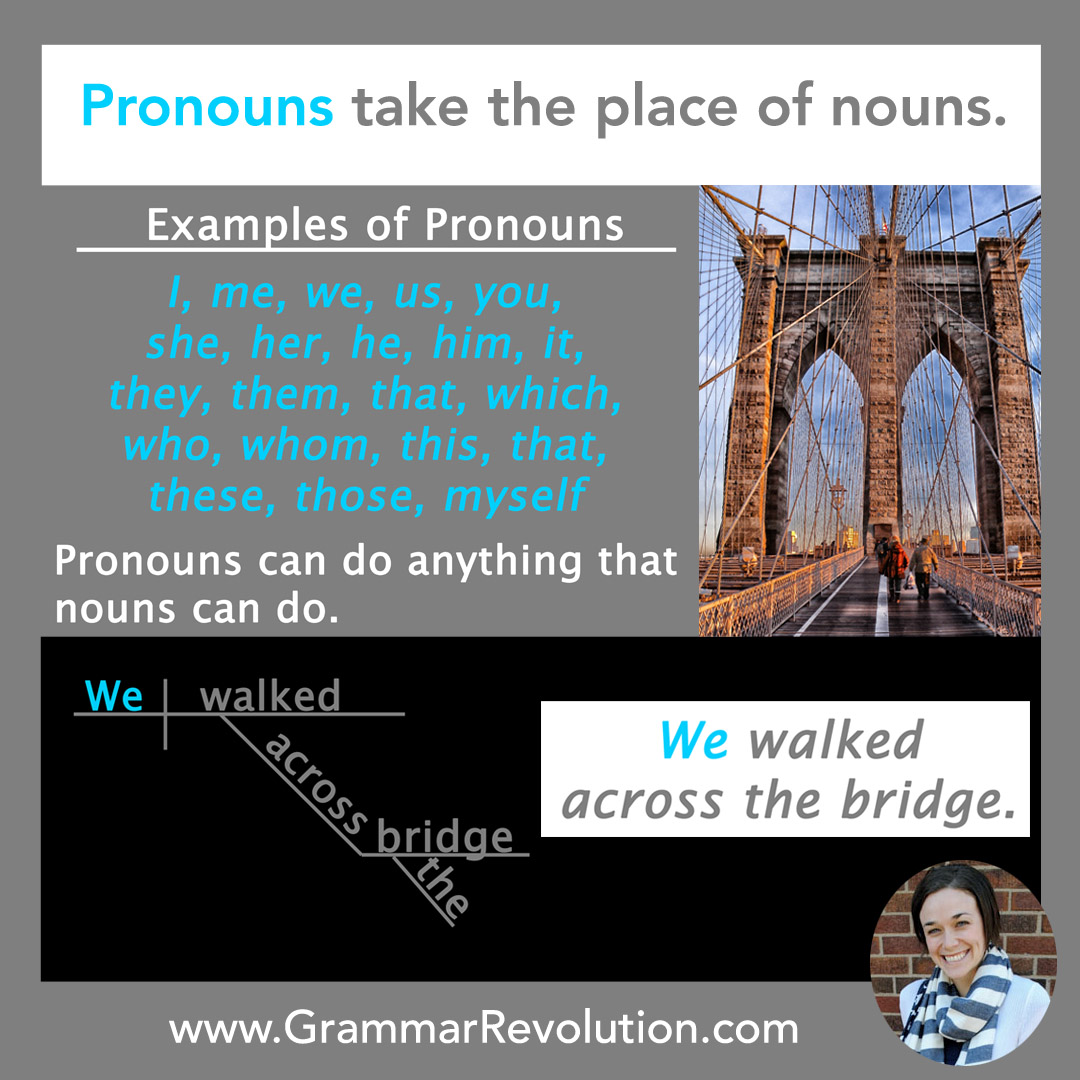
Examples: he, she, it, they, someone, who
Let's look at a few example sentences.
- Erik Weihenmayer is a blind mountain climber. (noun)
- He is a blind mountain climber. (pronoun)
Do you see how the pronoun he took the place of the noun Erik Weihenmayer? We can also put the noun and pronoun in the same sentence.
- Not only is Erik Weihenmayer a mountain climber, but he is also a motivational speaker.
If we didn't have pronouns, we would have to write that sentence like this.
- Not only is Erik Weihenmayer a mountain climber, but Erik Weihenmayer is also a motivational speaker.
That doesn't sound good! Thank goodness for pronouns!
If we didn't have them, we would have to keep saying Erik Weihenmayer every time that we wanted to refer to him. (Look! I just used the pronoun him to refer to Erik Weihenmayer!)
So, what is a pronoun? Close your eyes and see if you can remember the definition!
Antecedents
What's missing from the following example?
He said, "I'm a great believer in luck, and I find that the harder I work, the more I have of it."
You should be asking yourself WHO is HE? You don't know because I have not given you the antecedent. An antecedent is the noun that a pronoun is replacing or referring to.
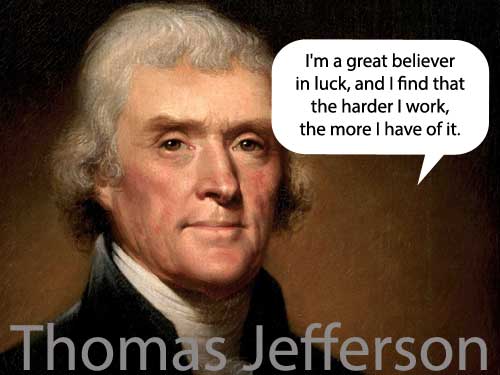
Thomas Jefferson was the third President of the United States.
He said, "I'm a great believer in luck, and I find that the harder I work, the more I have of it."
Now you should know whom I am talking about because I have provided the antecedent for he, Thomas Jefferson.
Do you want to hear something strange? Not all pronouns have antecedents! Sometimes we don't know whom exactly we are talking about.
Someone broke my vase!
You might be able to use that to your advantage.
Mom, someone broke your vase.
It certainly wasn't YOU, right?
Warning!
Knowing the above information and looking at this list of pronouns should be enough for you to answer that burning question, "What is a pronoun?"
If you want more in-depth information, keep reading to learn about the different types of pronouns, but don't get bogged down. Just knowing what we've covered so far might be all that you need right now.
Got it? Good.
Types of Pronouns
There are many different types of pronouns. Below you'll find a short description and a few examples of each. For more examples, see the list of pronouns.
Personal Pronouns
Here are the personal pronouns.
I, me, we, us, you, she, her, he, him, it, they, them
For each of these pronouns, we can tell the...
- Person (Who is speaking?)
- Number (Is the pronoun singular or plural?)
- Gender (Is the pronoun masculine, feminine, or neuter?)
For instance, she is third person (the person being spoken about), singular, feminine while we is first person (the people speaking), plural, neuter.
Relative Pronouns
These little guys introduce relative clauses (dependent adjective clauses).
who, whom, whose, that, which
This is the cookie that I want to eat.
That refers to the noun cookie, and it introduces the relative clause that I want to eat.
Demonstrative Pronouns
There are only four demonstrative pronouns. We use them to point out particular people or things.
this, that, these, those
Sometimes, those words are used before nouns. In those cases, they are adjectives, not pronouns. (Remember, adjectives describe nouns.)
Bring me that book. (adjective)
Bring me that. (pronoun)
Indefinite Pronouns
The prefix in- means not. Indefinite pronouns are not definite. We don't know whom or what these refer to!
anyone, something, all, most, some
Someone yelled my name.(Who? We don't know.)
Everyone looked at me. (Who exactly? We don't know.)
When indefinite pronouns are used before nouns, they are actually acting as adjectives, not pronouns.
Both people smiled at me. (adjective)
Both smiled at me. (pronoun)
Reflexive & Intensive Pronouns
These two types of pronouns end in -self or -selves.
himself, herself, myself, itself
Those words have different names depending on how they are being used.
A reflexive pronoun is used to refer to the subject of the sentence.
I will go to the school myself. (reflexive)
An intensive pronoun is used to emphasize another noun.
He himself visited the school. (intensive)
Interrogative Pronouns
These are pronouns that are found in questions.
Another name for a question is an interrogative sentence. Interrogative pronouns often begin interrogative sentences.
what, whom, whose, who, which
Who stole the cookie from the cookie jar?
Which jacket should I wear?
Possessive Pronouns
Possessive pronouns show ownership. Another word for ownership is possession.
his, hers, your, theirs
When possessive pronouns are used before nouns, they are actually being used as adjectives, not pronouns.
Our family has vacation next week. (adjective)
That car is ours. (pronoun)
If you'd like to teach or learn grammar the easy way—with sentence diagrams—check out our Get Smart Grammar Program.
It starts from the very beginning and teaches you grammar and sentence diagramming in easy, bite-size lessons.

Hello! I'm Elizabeth O'Brien, and my goal is to get you jazzed about grammar.
I
love your program! I am using the videos to help teach my students
note taking strategies as well. It has been fun to watch them grow in
confidence in grammar and note taking!
- Amy, Classroom Teacher
This is original content from https://www.english-grammar-revolution.com/what-is-a-pronoun.html
What is a pronoun? You know now, right?
Our Free Guide Gives You A Fun Way
To Teach And Learn The Basics v

Elizabeth O'Brien is the creator of Grammar Revolution.
Her lessons are guaranteed to give you more confidence in your communication skills and make you smile. :)
- Home
- Parts of Speech
- Pronouns



Home BLOG SHOP Contact PRIVACY POLICY Your Purchases
Copyright © 2009 - 2025 Grammar Revolution. All Rights Reserved.
JOIN OUR PRIVATE FACEBOOK GROUP RSS INSTAGRAM