What is a verb?
What is a verb?
- Home
- Parts of Speech
- Verbs
What is a verb? A verb is a word that expresses an action or a state of being.
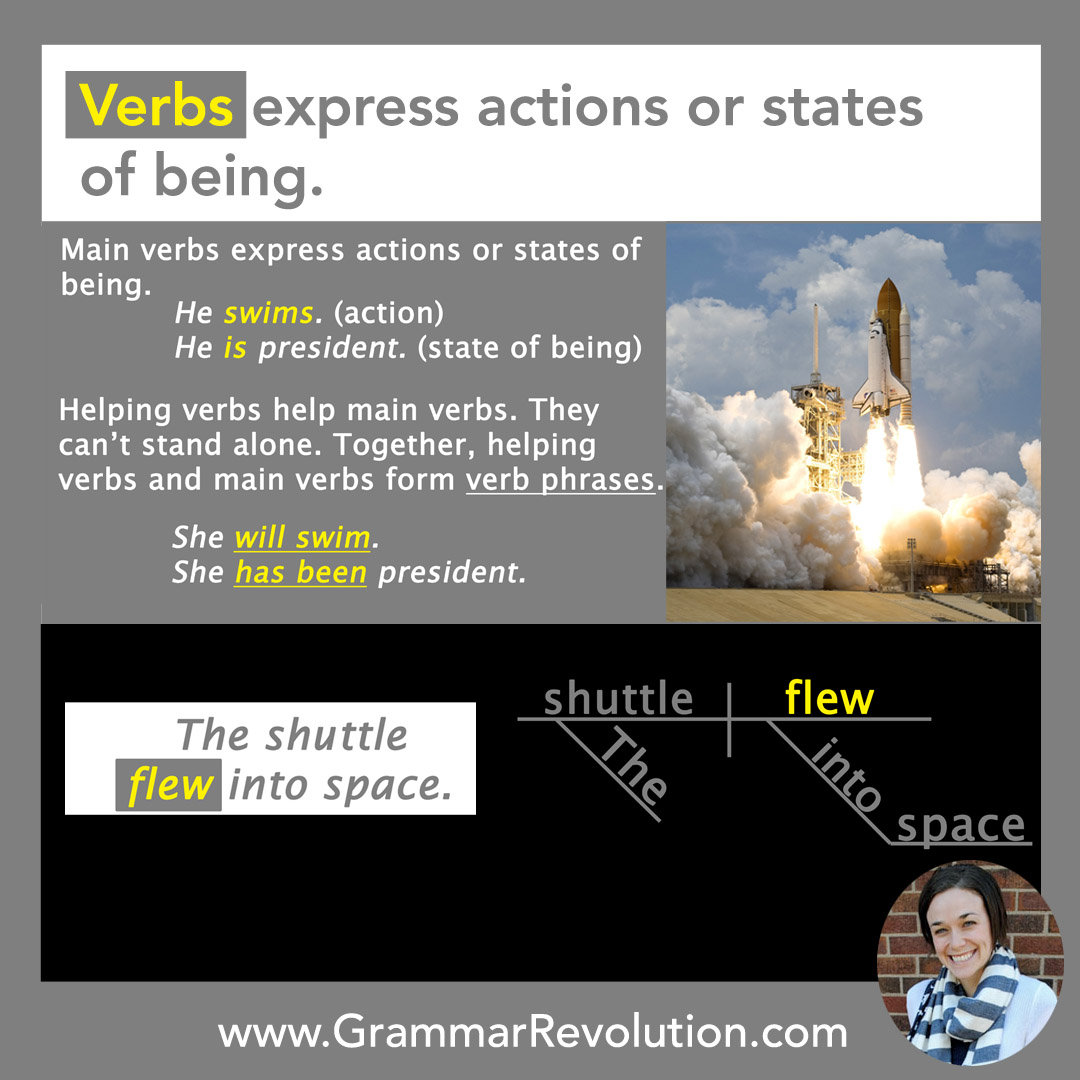
As you can see from that definition, there are two main categories of verbs: action verbs and state of being verbs (also known as linking verbs).
Because action verbs and linking verbs are strong enough to be used in sentences all by themselves, they are called main verbs.
I love cheese. I turned the page. (action verbs)
I am a teacher. I turned green. (linking verbs)
But wait! There is also a third category of verbs which doesn't get any glory. They are the helping verbs. The reason that these guys don't get any of the fame that action and linking verbs get is because they don't stand alone as main verbs.
Click here to see a list of all 24 helping verbs and to hear the helping verbs song.
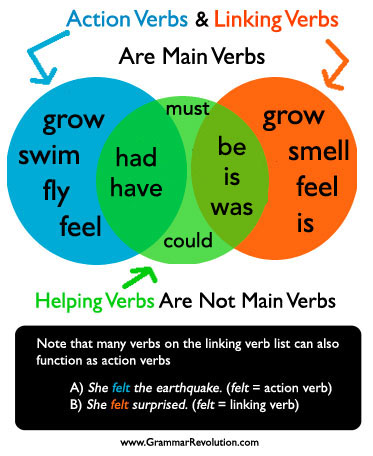
Helping verbs always help either an action verb or a linking verb.
I will play the piano. (will = helping verb, play = action verb)
I will be a teacher. (will = helping verb, be = linking verb)
Some verbs can function as main verbs or helping verbs, but they will only do one job at a time in a sentence.
I have a cat. (have = main verb, action verb)
I have been reading a great book. (have = helping verb)
I am a teacher. (am = main verb, linking verb)
I am cooking dinner for my family. (am = helping verb)
What is a verb? Let's look at some examples of verbs!
| Action verb with no helping verb | |
| Helping verb helping an action verb | |
| Two helping verbs helping an action verb |
When you have a helping verb along with an action or linking verb, all of those verbs together are called a verb phrase.
Here are some examples of sentences with verb phrases.
| helping verb | will |
| main verb (action verb) | eat |
| verb phrase | will eat |
| helping verbs | have been |
| main verb (linking verb) | feeling |
| verb phrase | have been feeling |
What is a verb? Got it all? Here's a summary.
- There are three categories of verbs (action, linking, helping).
- Only two can be main verbs (action, linking). Main means that the verb is strong enough to be the only verb in the sentence.
- Helping verbs are not main verbs. They help action and linking verbs.
- A helping verb and a main verb working together are called a verb phrase.
The Four Verb Types
For the next little while, we're going to focus on main verbs. So, forget about those poor little helping verbs for a bit, and let's turn our attention to action verbs and linking verbs. These two kinds of main verbs can act in four different ways.
| Transitive Active John kicked the ball. |
Intransitive Complete The ball rolled. |
| Transitive Passive The ball was kicked. |
Intransitive Linking John felt happy. |
1. Intransitive Complete Verbs
These guys are action verbs, so we know that they show action. Note that they don't not transfer their action to anyone or anything. They make sense without having to transfer action anywhere.
The ball rolled. Clocks tick. Buses move.
2. Transitive Active Verbs
These action verbs do transfer their action to someone or something. That means that something or someone is always being acted upon.
John kicked the ball.
Ball is receiving the action kicked.
The receiver of the action in this kind of verb is called the direct object, so in our example sentence, ball is the direct object.
Every single transitive active sentence must have a direct object, and the direct object always receives the action.
Cats drink milk. Clocks make noise. I lost my ticket.
- Milk is receiving the action of drink. It is what cats drink. It is the direct object.
- Noise is receiving the action of make. It is what clocks make. It is the direct object.
- Ticket is receiving the action of lost. It is what I lost. It is the direct object.
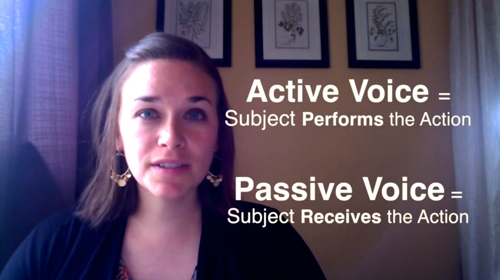
These verbs are all written in the what is called the active voice.

3. Transitive Passive Verbs
These verbs also show action, and they also transfer their action to a receiver.
Do you remember that in transitive active verbs, the receiver was the direct object? I hope so! Well, guess what? In transitive passive verbs, the receiver of the action is the subject!
The ball was kicked. The house was demolished.
Who is receiving the action in those sentences?
Ball received the action of kick and house received the action of demolished. Ball and house are the subjects of those sentences.
Notice that we may not actually know who initiated the action. (Who kicked the ball?) Sometimes we find this out in a prepositional phrase.
The ball was kicked by John.
The house was demolished by the storm.
These verbs are written in what is called the passive voice. This simply means that the subjects are receiving the action.
4. Intransitive Linking
Linking verbs differ from the three other verb types because they are the only verb type that does not express any action. What in the world do linking verbs do if they don't show action? Well, linking verbs tell us about the state or condition of the subject.
They link the subject of a sentence with either a noun that renames the subject or an adjective that describes the subject. Nouns that rename the subject are called predicate nouns. Adjectives that describe the subject are called predicate adjectives.
Milk tastes delicious. Clocks are helpful. I am the bus driver!
It may help you to think of linking verbs as an equal sign between the subject and a predicate noun or a predicate adjective.
| I am a teacher. | I = teacher |
| The soup is salty. | soup = salty |
- Am is linking the subject I with the predicate noun teacher.
- Is is linking the subject soup with the predicate adjective salty.
One More Thing... Beware!
There's one more thing that I want to clarify before you can be crowned an official verbs pro. Here it is:
Many words have the ability to function as different types of verbs. You will only know what type of verb it is by looking at the sentence to see how it is acting.
For example, the verb turned could be a transitive active verb that has a direct object, or it could be a linking verb. Check it out!
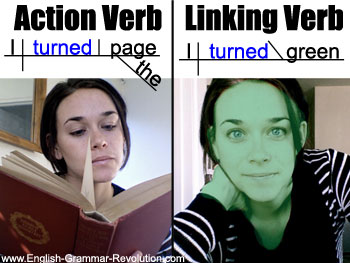
I turned the page. (turned = transitive active verb)
I turned green. (turned = intransitive linking verb)

You read all the way to the bottom of this lesson, and that means that I can now crown you a master of verb knowledge.
Congratulations!
Search Engine Optimization
I'm supposed to write, "What is a verb?" three more times on this page so that people using Google can find it, but I'd rather shove a spoon into my eye than continue trying to weave that phrase into a normal paragraph. So, I'm just going to write it twice without weaving it into the text. What is a verb? What is a verb? What is a verb? Ahh. That's much better. Thank you for letting me do that.
Hello! I'm Elizabeth O'Brien, and my goal is to get you jazzed about grammar.
Where have you been all our homeschooling life? You are talented at explaining grammar in a way that my youngest (of 8) really gets it! Thank you!
- Susan, Homeschooler
If you'd like to teach or learn grammar the easy way—with sentence diagrams—check out our Get Smart Grammar Program.
It starts from the very beginning and teaches you grammar and sentence diagramming in easy, bite-size lessons.
This is original content from https://www.english-grammar-revolution.com/what-is-a-verb.html
Our Free Guide Gives You A Fun Way
To Teach And Learn The Basics v

Elizabeth O'Brien is the creator of Grammar Revolution.
Her lessons are guaranteed to give you more confidence in your communication skills and make you smile. :)
- Home
- Parts of Speech
- Verbs



Home BLOG SHOP Contact PRIVACY POLICY Your Purchases
Copyright © 2009 - 2024 Grammar Revolution. All Rights Reserved.
JOIN OUR PRIVATE FACEBOOK GROUP RSS