Download your free grammar guide here.
What is an adjective?
What is an adjective?
- Home
- Parts of Speech
- Adjectives
What is an adjective? Adjectives are words that describe nouns or pronouns.
That definition will only be helpful if you know what nouns and pronouns are!
- Nouns are words that name people, places, things, or ideas. (mother, vase, road)
- Pronouns are words that can take the place of nouns. (she, it, anyone)
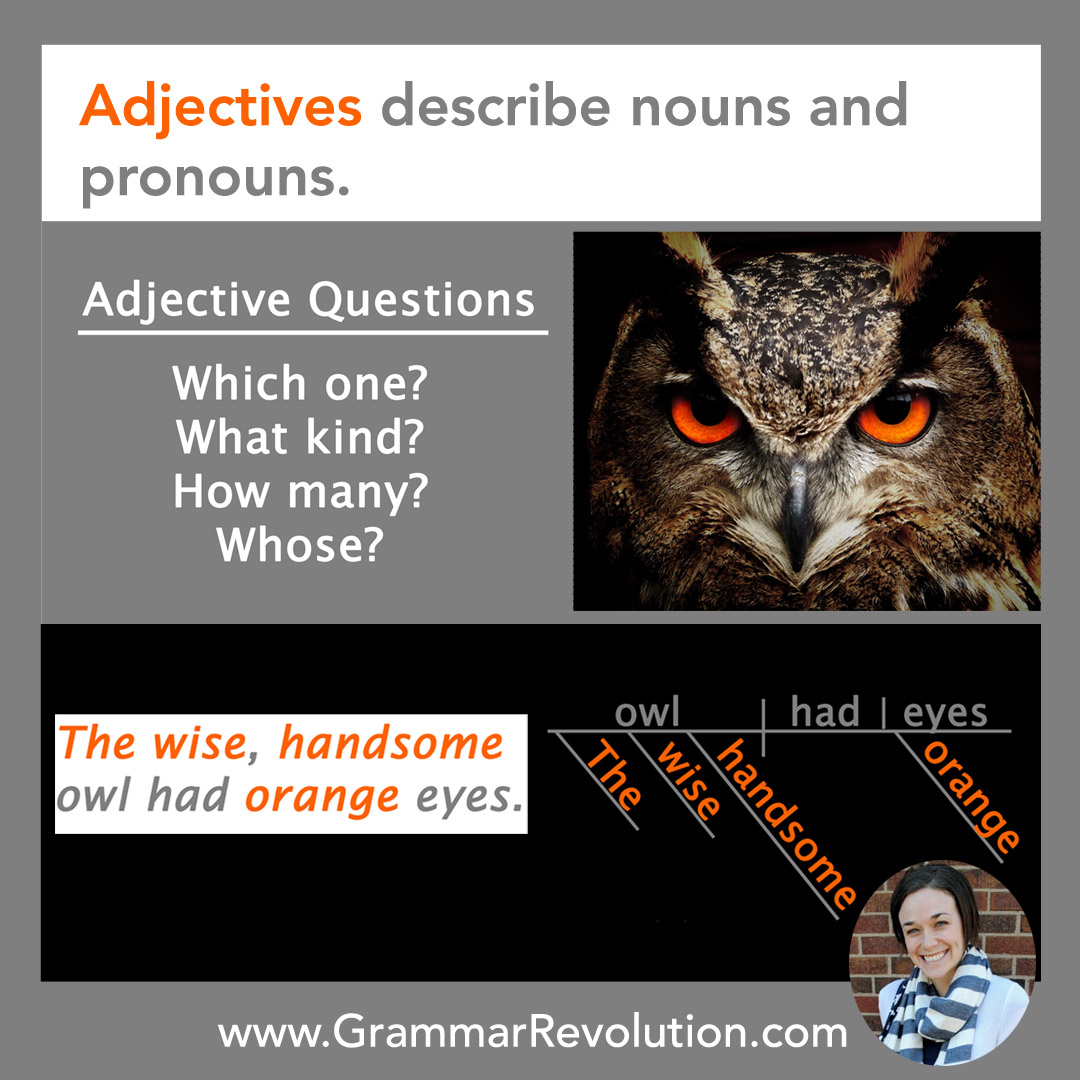
The adjectives in the following examples are in bold. They come right before the nouns that they are modifying.
bright sun yellow ducks sixteen candles Caroline's book
Let's use a sentence diagram to see what adjectives do. Sentence diagrams are pictures of sentences. The way that the words are arranged in the picture helps us see how each word is related to the other words in the sentence.
Since adjectives modify nouns, we diagram them on slanted lines underneath the nouns that they are modifying. Can you tell what the adjective are in the sentence diagram below?
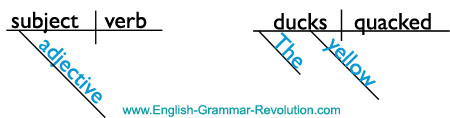
When we look at that sentence diagram, we can easily see that the adjectives the and yellow are modifying the noun duck.
Learn more about diagramming adjectives here.
What are the adjective questions?
Did you know that there are certain questions we can ask that help us find adjectives? It's true! We call these the adjective questions.
Knowing the adjective questions will help you know for sure whether any word is acting as an adjective.
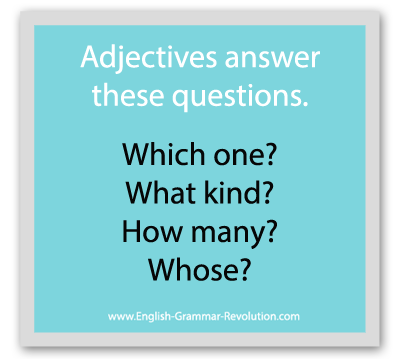
Adjectives answer at least one of these adjective questions.
1. Which one? (yellow, the, that)
2. What kind? (furry, plastic, special)
3. How many? (sixteen, several, many)
4. Whose? (Caroline's, his, its, John's)
Let's look at this cute monkey here. How would you describe it? You could say it's a furry monkey. The adjective furry describes the noun monkey and answers the adjective question Which one? or What kind?
Which monkey? The furry monkey. What kind of monkey? The furry monkey.
Let's pretend that this monkey belongs to a girl named Bianca. You could say that it's Bianca's monkey. The adjective Bianca's describes the noun monkey and answers the adjective question Whose? Whose monkey? Bianca's monkey.

Adjective or Pronoun?
Some words can be either adjectives or pronouns depending on how they're acting in the sentence. How are you going to tell the difference?
Well, what is an adjective? It's a word that describes a noun or pronoun, right? So, if a word describes a noun or pronoun, it's an adjective. If a word takes the place of a noun instead of describing it, then it is a pronoun.
| Adjective | Why? |
| Both pens fell on the floor. | Both describes the noun pens, and it answers the adjective question, Which ones? |
| Gee, Martha, this pie is delicious! | This describes the noun pie, and answers the adjective question, Which pie? |
| Pronoun | Why? |
| Both of us are going to the movie. | Both is not describing a noun. |
| Is this my piece? | This does not describe a noun. |
What are comparative & superlative adjectives?
Many adjectives can have different degrees. By this I mean that something can have more or less of an adjective's quality. For instance, you may find the weather in California to be hot, Tahiti's weather to be hotter, and the Sahara Desert's to be the hottest.

California is hot.
(positive adjective)

Tahiti is hotter.
(comparative adjective)
The desert is the hottest.
(superlative adjective)
Do you see how there are different degrees of the adjective hot? We've just used the comparative and superlative forms of the word hot to show this adjective's different degrees.
Comparative Adjectives
Use the comparative form when you're comparing two things. In the examples below, we're comparing Richard Branson and his neighbor.
Richard Branson is richer than his neighbor.
Richard Branson is more adventurous than his neighbor.
Most comparative adjectives end in -er (richer, happier, taller) or begin with more (more beautiful, more peaceful, more spontaneous).
There are also irregular comparatives which do not follow this -er or more pattern (better, less, worse).
Superlative Adjectives
Use the superlative form when you're comparing three or more things. In the examples below, we're comparing good old Richard with his neighbor AND Tim Ferriss.
Out of Richard, his neighbor, and Tim Ferriss, Richard is the richest.
Out of Richard, his neighbor, and Tim Ferriss, Tim is the most adventurous.

Richard Branson

Let's just pretend this guy is Richard Branson's neighbor.

Tim Ferriss
Most superlative adjectives end in -est (richest, happiest, tallest) or begin with most (most beautiful, most peaceful, most spontaneous).
But, just like comparative adjectives, there are some irregularities (best, least, worst). In the charts below, positive simply means the form of the adjective before it is in its comparative or superlative form.
Regular Comparatives and Superlatives
| Positive | Comparative | Superlative |
| happy | happier | happiest |
| beautiful | more beautiful | most beautiful |
Irregular Comparatives and Superlatives
| Positive | Comparative | Superlative |
| good | better | best |
| little | less | least |
| bad | worse | worst |
Neither Comparative Nor Superlative
Some adjectives can't change degrees. For example, a woman is either pregnant or she isn't. There is no pregnanter or pregnantest. Your best buddy might be your main man, but you don't have a mainer or mainest man.
Feeling overwhelmed? Just remember the answer to the question, What is an adjective? (It's a word that describes a noun or pronoun, remember?) That's the most important thing to remember.
Articles, Proper Adjectives, & Predicate Adjectives
There are many different kinds of adjectives, and we'll explore three of them below: articles, proper adjectives, and predicate adjectives.
What are articles?
Articles are special kinds of adjectives.* (By the way, what is an adjective? Do you remember? Good.)
* Please note that when people categorize words into nine parts of speech, they say that articles and determiners are in their own category. Here at Grammar Revolution, we categorize words into eight parts of speech, and we say that articles are a subcategory of adjectives.
There are only three articles in the English language. That's easy! They are the, a, and an.
- The = Definite Article
The article the is called a definite article.
That's because it points out a definite, or specific person, place, or thing.
If I say Read the book., I'm not referring to any old book. I'm referring to a specific book.
- A & An = Indefinite Articles
The articles a and an are called indefinite articles. That's because they don't point out specific people, places, or things.
If I say Read a book., you could read any book that you wanted to read.
Use a before words that begin with consonant sounds and use an before words that begin with vowel sounds.
So, you would say a game (g is a consonant sound), but an ant (a is a vowel sound).
It seems kind of funny, but articles answer the adjective question, Which one?
What are proper adjectives?
Proper adjectives start with capital letters just like proper nouns. In fact, proper adjectives are made from proper nouns.
They normally answer the adjective question, What kind?
| Proper Noun | Proper Adjective |
| America | American cars |
| English | English grammar |
| Mexico | Mexican food |
What are predicate adjectives?
Predicate adjectives are a bit tricky because they involve linking verbs. Go ahead and read about them, but don't lose any sleep over memorizing this stuff right now.
Predicate adjectives come after linking verbs and describe the subject of the sentence.
I feel happy.
Happy describes the subject I, and it comes after the linking verb feel.
This banana is ripe!
Ripe describes the subject banana, and it comes after the linking verb is.
When we diagram predicate adjectives, we don't put them on a slanted line under the noun that they modify. We actually put them on the same line as the subject and the verb. This is because the predicate adjective is an important part of the sentence. We need the predicate adjective in order for our sentence to make sense.
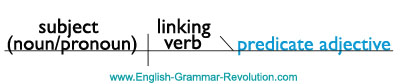
Between the linking verb and the predicate adjective, we draw a slanted line that points back toward the subject to show that the predicate adjective is describing the subject. You can learn more about diagramming predicate adjectives here.
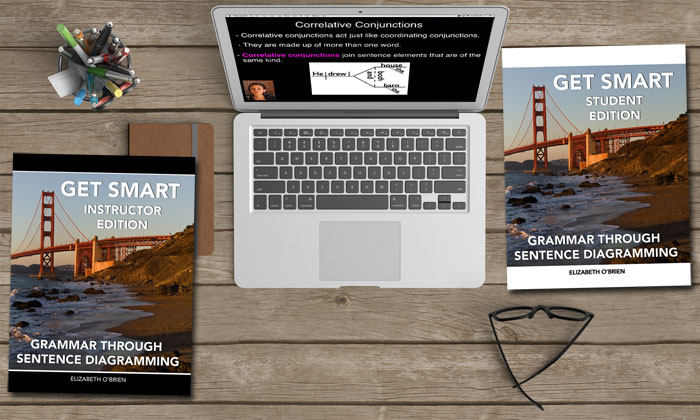
If you'd like to teach or learn grammar the easy way—with sentence diagrams—check out our Get Smart Grammar Program.
It starts from the very beginning and teaches you grammar and sentence diagramming in easy, bite-size lessons.

Hello! I'm Elizabeth O'Brien, and my goal is to get you jazzed about grammar.
Join my email list for grammar tips, diagramming fun, and updates about new lessons and resources.
My students love diagramming and are learning so much. Thank you for your inspiration and instruction.
- Destiny, Teacher
This is original content from https://www.english-grammar-revolution.com/what-is-an-adjective.html
Our Free Guide Gives You A Fun Way
To Teach And Learn The Basics v

Elizabeth O'Brien is the creator of Grammar Revolution.
Her lessons are guaranteed to give you more confidence in your communication skills and make you smile. :)
Other Helpful Resources
- Identify the adjectives with this PDF worksheet. Psst! This worksheet gives you a good introduction to identifying adjectives, but it doesn't include all of the adjectives in each sentence. When looking over your answers, include the articles (the, a, and an) as well as possessive pronouns functioning as adjectives (her, his, etc.).
- Home
- Parts of Speech
- Adjectives



Home BLOG SHOP Contact PRIVACY POLICY Your Purchases
Copyright © 2009 - 2026 Grammar Revolution. All Rights Reserved.